Type 2 diabetes (SURPASS-1, monotherapy vs placebo, 40 weeks)
Phase IIIStudies report mean HbA1c reductions of −1.87% / −1.89% / −2.07% with tirzepatide 5 / 10 / 15 mg vs +0.04% with placebo.
— Rosenstock et al., Lancet 2021;398(10295):143–155
Also Known As: LY3298176, Mounjaro, Zepbound
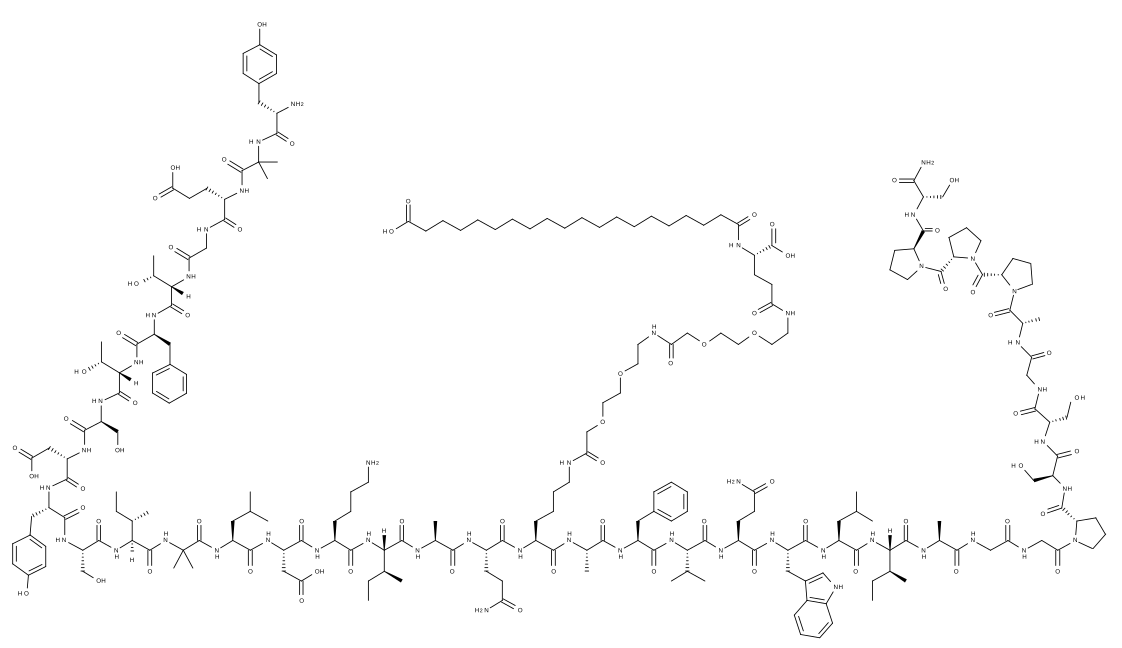
Tirzepatide is a synthetic 39-amino-acid peptide built on the human GIP backbone that simultaneously activates the glucose-dependent insulinotropic polypeptide receptor (GIPR) and the glucagon-like peptide-1 receptor (GLP-1R). Two α-aminoisobutyric-acid substitutions (Aib₂ and Aib₁₃) block DPP-4 cleavage, and a C20 fatty di-acid is conjugated to lysine 20 via a γGlu-AEEA-AEEA linker to enable albumin binding and a half-life of approximately five days. Tirzepatide is approved by the FDA and the EMA for type 2 diabetes (Mounjaro), for chronic weight management (Zepbound), and for moderate-to-severe obstructive sleep apnea in adults with obesity (Zepbound).
Tirzepatide is a once-weekly synthetic 39-amino-acid peptide that simultaneously activates GIPR and GLP-1R, with binding affinity intentionally biased toward GIPR (Kᵢ ≈ 0.135 nM at GIPR vs ≈ 4.23 nM at GLP-1R).
Tirzepatide was engineered from the native GIP backbone by Coskun et al. (2018), with two α-aminoisobutyric-acid (Aib) substitutions at positions 2 and 13 introduced to block DPP-4-mediated proteolysis and stabilise the active conformation. A C20 fatty di-acid (1,20-eicosanedioic acid) is conjugated to the side-chain ε-amine of lysine 20 through a γGlu-AEEA-AEEA linker; this acyl chain binds serum albumin, extending plasma half-life to approximately five days and enabling once-weekly subcutaneous dosing. Dual GIPR + GLP-1R agonism produces glucose-dependent stimulation of insulin secretion and suppression of inappropriate glucagon release, slowed gastric emptying that blunts post-prandial glucose excursions, and central anorexigenic signalling that reduces caloric intake and body weight. Receptor pharmacology is intentionally imbalanced (greater GIPR than GLP-1R activity), and at GLP-1R the molecule is biased toward cAMP generation over β-arrestin recruitment — a profile hypothesised to reduce receptor desensitisation while preserving downstream metabolic effects.
Tirzepatide has been evaluated in a comprehensive Phase III programme in type 2 diabetes (SURPASS), obesity (SURMOUNT), heart failure with preserved ejection fraction (SUMMIT), obstructive sleep apnea (SURMOUNT-OSA), and MASH (SYNERGY-NASH).
Studies report mean HbA1c reductions of −1.87% / −1.89% / −2.07% with tirzepatide 5 / 10 / 15 mg vs +0.04% with placebo.
— Rosenstock et al., Lancet 2021;398(10295):143–155
Tirzepatide was superior to semaglutide on HbA1c reduction (estimated treatment difference up to −0.45%) and on body weight (1.9–5.5 kg additional reduction).
— Frías et al., NEJM 2021;385(6):503–515
Studies report mean body-weight change of −15.0% (5 mg), −19.5% (10 mg), and −20.9% (15 mg) with tirzepatide vs −3.1% with placebo.
— Jastreboff et al., NEJM 2022;387(3):205–216
Studies report MASH resolution without worsening of fibrosis in 51.8% (5 mg), 62.8% (10 mg), and 73.3% (15 mg) of tirzepatide-treated participants vs 13.2% on placebo.
— Loomba et al., NEJM 2024;391(4):299–310
Studies report change in apnea-hypopnoea index (AHI) of −25.3 / −29.3 events·h⁻¹ with tirzepatide vs −5.3 / −5.5 with placebo (treatment differences of −20.0 and −23.8 events·h⁻¹).
— Malhotra et al., NEJM 2024;391(13):1193–1205
Studies report a composite of CV death or worsening heart-failure event in 9.9% on tirzepatide vs 15.3% on placebo (HR 0.62; 95% CI 0.41–0.95; P=0.026).
— Packer et al., NEJM 2024;391(22):2087–2099
Studies report primary 3-point MACE of 12.2% on tirzepatide vs 13.1% on dulaglutide (non-inferior, P=0.003); expanded MACE-4 reduced with tirzepatide (HR 0.88; 95% CI 0.80–0.96).
— Nicholls et al., NEJM 2025;393:2409–2420
Observed in research settings
Across the SURPASS, SURMOUNT, SUMMIT, SURMOUNT-OSA, and SYNERGY-NASH programmes the adverse-event profile observed in research settings was dominated by mild-to-moderate gastrointestinal events that were typically dose-dependent and most pronounced during dose escalation. Serious events were uncommon but included pancreatitis, gallbladder disease, and hypersensitivity reactions.
Coskun T, Sloop KW, Loghin C, et al. LY3298176, a novel dual GIP and GLP-1 receptor agonist for the treatment of type 2 diabetes mellitus: From discovery to clinical proof of concept. Mol Metab 2018;18:3–14. 2018 .
Rosenstock J, Wysham C, Frías JP, et al. Efficacy and safety of a novel dual GIP and GLP-1 receptor agonist tirzepatide in patients with type 2 diabetes (SURPASS-1): a double-blind, randomised, phase 3 trial. Lancet 2021;398(10295):143–155. 2021 .
Frías JP, Davies MJ, Rosenstock J, et al. Tirzepatide versus Semaglutide Once Weekly in Patients with Type 2 Diabetes (SURPASS-2). N Engl J Med 2021;385(6):503–515. 2021 .
Jastreboff AM, Aronne LJ, Ahmad NN, et al. Tirzepatide Once Weekly for the Treatment of Obesity (SURMOUNT-1). N Engl J Med 2022;387(3):205–216. 2022 .
Loomba R, Hartman ML, Lawitz EJ, et al. Tirzepatide for Metabolic Dysfunction-Associated Steatohepatitis with Liver Fibrosis (SYNERGY-NASH). N Engl J Med 2024;391(4):299–310. 2024 .
Malhotra A, Grunstein RR, Fietze I, et al. Tirzepatide for the Treatment of Obstructive Sleep Apnea and Obesity (SURMOUNT-OSA). N Engl J Med 2024;391(13):1193–1205. 2024 .
Packer M, Zile MR, Kramer CM, et al. Tirzepatide for Heart Failure with Preserved Ejection Fraction and Obesity (SUMMIT). N Engl J Med 2024;391(22):2087–2099. 2024 .
Nicholls SJ, Pavo I, Bhatt DL, et al. Cardiovascular Outcomes with Tirzepatide versus Dulaglutide in Type 2 Diabetes (SURPASS-CVOT). N Engl J Med 2025;393:2409–2420. 2025 .
U.S. Food and Drug Administration Mounjaro (tirzepatide) Highlights of Prescribing Information (2025 revision). FDA Drug Label. 2025 .
Long-Acting GLP-1 Receptor Agonist
Approved long-acting GLP-1 receptor agonist administered once weekly subcutaneously or once daily orally, evaluated in pivotal trials across type 2 diabetes, obesity, cardiovascular risk reduction, chronic kidney disease, and MASH.
View DetailsTriple GLP-1 / GIP / Glucagon Receptor Agonist
Investigational triple GLP-1 / GIP / glucagon receptor agonist administered as a once-weekly subcutaneous peptide, evaluated in clinical trials for obesity and type 2 diabetes.
View DetailsFixed-dose Amylin/CTR Agonist + GLP-1 Receptor Agonist Combination (Incretin Class)
Investigational once-weekly fixed-dose combination of cagrilintide (long-acting amylin/calcitonin receptor agonist) and semaglutide (long-acting GLP-1 receptor agonist) developed by Novo Nordisk; U.S. FDA NDA submitted in December 2025.
View Details