Obesity / weight management (adults without T2D)
Phase IIStudies report a least-squares mean body-weight change of −24.2% at 48 weeks at the 12 mg dose vs −2.1% on placebo (n=338).
— Jastreboff et al., NEJM 2023;389(6):514–526
Also Known As: LY3437943, LY-3437943
Retatrutide (LY3437943) is a synthetic 39-amino-acid lipidated peptide that simultaneously activates the GLP-1, GIP and glucagon receptors. The triple-agonist architecture combines appetite-suppressing and insulinotropic incretin effects with glucagon-mediated increases in basal energy expenditure. It is currently in Phase 3 clinical development by Eli Lilly under the TRIUMPH program.
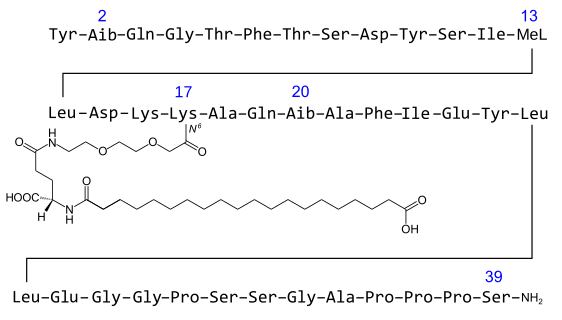
Retatrutide is a synthetic peptide that simultaneously engages three metabolic G-protein-coupled receptors — GLP-1, GIP and glucagon. The combined activation pairs incretin-driven appetite and glycemic control with glucagon-driven energy expenditure.
Retatrutide is engineered to engage three metabolic GPCRs simultaneously, with reported in vitro potency biased toward GIPR while maintaining balanced GLP-1R and GCGR activity. GLP-1R and GIPR co-activation drive glucose-dependent insulin secretion and reduce caloric intake via central pathways and slowed gastric emptying. GCGR agonism is intended to raise basal energy expenditure and promote hepatic fatty-acid oxidation, theoretically amplifying weight loss beyond what GLP-1/GIP dual agonists achieve. The molecule incorporates 2-aminoisobutyric acid at positions 2 and 20 to block dipeptidyl peptidase-4 cleavage, and a C20 fatty diacid linked through a γ-Glu-AEEA spacer at lysine 17 enables reversible albumin binding, supporting a half-life compatible with once-weekly subcutaneous dosing. Cryo-EM studies have resolved retatrutide bound to all three receptors.
Retatrutide is being evaluated in a comprehensive clinical program across multiple indications, with published Phase 2 data in obesity, type 2 diabetes and MASLD/MASH, and the first positive Phase 3 readout from the TRIUMPH program.
Studies report a least-squares mean body-weight change of −24.2% at 48 weeks at the 12 mg dose vs −2.1% on placebo (n=338).
— Jastreboff et al., NEJM 2023;389(6):514–526
At 36 weeks, the 12 mg dose was associated with HbA1c reductions of approximately −2.0 percentage points and body-weight reductions of approximately −16.9% from baseline (n=281).
— Rosenstock et al., Lancet 2023;402(10401):529–544
Studies report relative liver-fat reductions at 24 weeks of −81.4% (8 mg) and −82.4% (12 mg) vs +0.3% placebo; 86% of participants on the 12 mg dose achieved liver fat <5%.
— Sanyal et al., Nat Med 2024;30(7):2037–2048
At 68 weeks, participants on retatrutide 12 mg lost on average 28.7% of body weight; WOMAC pain scores fell by up to 4.5 points (~75.8%). A new dysesthesia signal was reported in 20.9% on 12 mg vs 0.7% on placebo.
— Eli Lilly press release, October 2025
Studies report dose-dependent reductions in total fat mass and visceral adipose tissue, with greater absolute fat-mass than lean-mass loss; lean-to-fat-loss ratios consistent with lifestyle-induced weight loss.
— Coskun et al., Lancet Diabetes Endocrinol 2025;13(8):674–684
Studies report that LY3437943 produced sustained body-weight reduction and improved glycemic control in obese mouse models, attributed to GCGR-mediated increases in energy expenditure combined with incretin-driven hypophagia.
— Coskun et al., Cell Metab 2022;34(9):1234–1247
Observed in research settings
Across Phase 2 and the first Phase 3 readouts, the safety profile is broadly consistent with the GLP-1 receptor agonist class — dominated by dose-dependent gastrointestinal adverse events that are mostly mild to moderate — with additional class-specific signals related to glucagon receptor activation and a recently reported dysesthesia signal at 12 mg in TRIUMPH-4.
Jastreboff AM, Kaplan LM, Frías JP, et al. Triple-Hormone-Receptor Agonist Retatrutide for Obesity — A Phase 2 Trial. N Engl J Med 2023;389(6):514–526. 2023 .
Rosenstock J, Frias J, Jastreboff AM, et al. Retatrutide, a GIP, GLP-1 and glucagon receptor agonist, for people with type 2 diabetes: a randomised, double-blind, placebo and active-controlled, parallel-group, phase 2 trial conducted in the USA. Lancet 2023;402(10401):529–544. 2023 .
Sanyal AJ, Kaplan LM, Frias JP, et al. Triple hormone receptor agonist retatrutide for metabolic dysfunction-associated steatotic liver disease: a randomized phase 2a trial. Nat Med 2024;30(7):2037–2048. 2024 .
Coskun T, Urva S, Roell WC, et al. LY3437943, a novel triple glucagon, GIP, and GLP-1 receptor agonist for glycemic control and weight loss: from discovery to clinical proof of concept. Cell Metab 2022;34(9):1234–1247.e9. 2022 .
Urva S, Coskun T, Loh MT, et al. LY3437943, a novel triple GIP, GLP-1, and glucagon receptor agonist in people with type 2 diabetes: a phase 1b, multicentre, double-blind, placebo-controlled, randomised, multiple-ascending dose trial. Lancet 2022;400(10366):1869–1881. 2022 .
Coskun T, Sloop KW, Loghin C, et al. Effects of retatrutide on body composition in people with type 2 diabetes: a substudy of a phase 2, randomised, placebo-controlled trial. Lancet Diabetes Endocrinol 2025;13(8):674–684. 2025 .
Eli Lilly and Company Lilly's triple agonist, retatrutide, delivered weight loss of up to an average of 71.2 lbs along with substantial relief from osteoarthritis pain in first successful Phase 3 trial (TRIUMPH-4). Press release, October 2025. 2025 .
Melanocortin Receptor Agonist (predominantly MC1R; α-MSH analogue)
Synthetic superpotent linear α-MSH analogue ([Nle⁴, D-Phe⁷]-α-MSH); MC1R agonist that drives cutaneous eumelanogenesis — approved as Scenesse® by the FDA (2019), EMA (2014) and TGA (2020) for photoprotection in erythropoietic protoporphyria.
View DetailsAMPK activator / purine nucleoside (exercise-mimetic research)
Purine nucleoside and AMPK activator, described in preclinical work as an "exercise mimetic". Not a peptide. Limited human data — research use only.
View DetailsMetabolic Fragment — engineered 16-aa lipolytic hGH-fragment analogue with an added N-terminal tyrosine (research reagent; failed clinical obesity candidate)
16-amino-acid synthetic peptide (YLRIVQCRSVEGSCGF) — the C-terminal hGH lipolytic fragment (residues 177–191) extended by an N-terminal tyrosine. NOT approved by the FDA, EMA, Health Canada or Australian TGA as a therapeutic. The Phase 2b OPTIONS obesity trial (n=536, 24 weeks) FAILED its primary weight-loss endpoint and the obesity programme was discontinued in 2007. On the WADA 2026 Prohibited List under Class S0 (with a secondary S2 reading). Research use only.
View Details