Actin-binding β-thymosin / healing & repair peptide (slug: healing-repair). Do NOT conflate with Thymosin α1, a TLR2/TLR9-mediated immune modulator from a separate gene family. Limited Human Data

TB-500

Also Known As: Thymosin beta-4, Thymosin β-4, Tβ4, TB4, Timbetasin, Fequesetide, TMSB4X protein, Ac-LKKTETQ, RGN-259, RGN-352, RGN-137

TB-500 is a deliberately ambiguous label: in peer-reviewed and patent literature, "TB-500" denotes the synthetic, N-acetylated heptapeptide Ac-Leu-Lys-Lys-Thr-Glu-Thr-Gln (Ac-LKKTETQ, residues 17–23 of full-length Thymosin β-4, CAS 885340-08-9, MW ~889 Da, proposed INN "fequesetide"). In research-chemical and veterinary commerce, "TB-500" is routinely sold as a synonym for full-length 43-amino-acid Thymosin β-4 (timbetasin, CAS 77591-33-4, MW ~4921 Da, UniProt P62328, encoded by the X-linked gene TMSB4X) — and it is this full-length form that has been studied in the human clinical programmes RGN-259 (topical ophthalmic), RGN-352 (intravenous) and RGN-137 (topical dermal). The two molecules are chemically distinct and are NOT interchangeable; any editorial statement must specify which form is intended. Thymosin β-4 is the major intracellular G-actin-sequestering peptide in mammalian cells; it binds globular actin 1:1, regulates the unpolymerised actin pool, and modulates cell migration, angiogenesis, and tissue repair. Studies report, in preclinical rodent cardiac models, infarct size reduction and epicardial-progenitor mobilisation (Bock-Marquette 2004 Nature; Smart 2007 Nature) as well as wound-healing activity partly mediated by the N-terminal cleavage product AcSDKP. Human clinical evidence is mixed: the RGN-259 ARISE programme (Phase 2/3 NCT02597803, Phase 3 NCT02974907) did not meet pre-specified co-primary endpoints in dry-eye disease, although secondary endpoints on central / inferior corneal staining reached significance; the Phase 3 neurotrophic-keratopathy trial (NCT02600429, Sosne 2022) showed a trend toward complete epithelial-defect healing at day 28 (P=0.0656) and significance by day 43 (P=0.0359). The RGN-352 IV cardiac programme (NCT01311518) was withdrawn before enrollment in 2011 after the FDA placed it on clinical hold for contract-manufacturer cGMP non-compliance; the RGN-137 epidermolysis-bullosa programme (NCT03578029) was terminated for business reasons. There is NO marketing approval from FDA, EMA, MHRA, PMDA or NMPA for any indication. The World Anti-Doping Agency lists both Thymosin β-4 and TB-500 explicitly under Class S2 (peptide hormones, growth factors and related substances and mimetics) of the 2026 Prohibited List — prohibited at all times, in- and out-of-competition. Thymosin β-4 (TB-500) is genetically and mechanistically unrelated to Thymosin α1 (Tα1, Zadaxin): different gene (TMSB4X vs PTMA), different chromosome (X vs 2), different protein family (β-thymosin vs pro-/parathymosin), different mechanism (G-actin sequestration vs TLR2/TLR9 immune agonism).
Identity & Chemistry

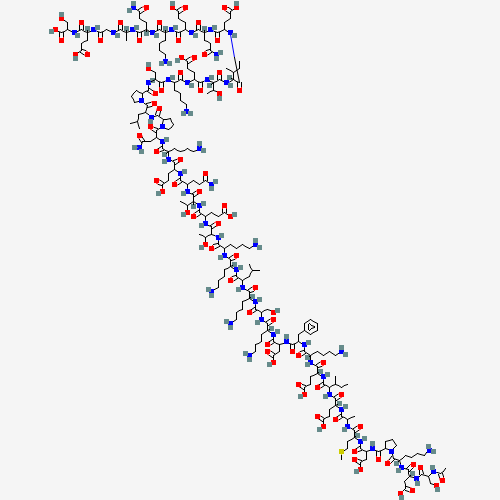
Two-dimensional chemical structure of full-length Thymosin β-4 (TB-500), a 43-residue N-terminally acetylated peptide encoded by the X-linked TMSB4X gene, shown as the linear peptide backbone with side chains. Source: PubChem CID 45382195.
Image credit: Structure data from PubChem CID 45382195, U.S. National Library of Medicine. · Public Domain (U.S. Government work — NCBI/PubChem)
Amino Acid Sequence
Full-length Thymosin β-4 (43 residues, N-terminus acetylated): Ac-Ser-Asp-Lys-Pro-Asp-Met-Ala-Glu-Ile-Glu-Lys-Phe-Asp-Lys-Ser-Lys-Leu-Lys-Lys-Thr-Glu-Thr-Gln-Glu-Lys-Asn-Pro-Leu-Pro-Ser-Lys-Glu-Thr-Ile-Glu-Gln-Glu-Lys-Gln-Ala-Gly-Glu-Ser (Ac-SDKPDMAEIEKFDKSKLKKTETQEKNPLPSKETIEQEKQAGES, UniProt P62328 / TMSB4X). Synthetic 7-residue fragment "TB-500" used in published peer-reviewed and patent literature: Ac-Leu-Lys-Lys-Thr-Glu-Thr-Gln-OH (Ac-LKKTETQ; residues 17–23 of full-length Tβ4; the active actin-binding motif).
Molecular Formula
C₂₁₂H₃₅₀N₅₆O₇₈S (full-length Thymosin β-4, 43-aa, PubChem CID 45382195) + C₃₈H₆₈N₁₀O₁₄ (synthetic 7-residue fragment Ac-LKKTETQ — the literature "TB-500")
Molecular Weight
~4921 g·mol⁻¹ (full-length Thymosin β-4, 43-aa, free acid; PubChem 45382195) + 889.018 g·mol⁻¹ (7-residue Ac-LKKTETQ fragment, the literature "TB-500"). Vendor-supplied research material is typically the trifluoroacetate (TFA) salt; per-vial mass exceeds the free-base mass quoted here.
CAS Number
77591-33-4 (full-length Thymosin β-4 / Timbetasin); 885340-08-9 (synthetic 7-residue fragment Ac-LKKTETQ / Fequesetide)
PubChem CID
45382195
IUPAC Name
Not standardly assigned at peptide length. For the 43-residue Thymosin β-4, refer to the one-letter sequence Ac-SDKPDMAEIEKFDKSKLKKTETQEKNPLPSKETIEQEKQAGES (UniProt P62328). For the 7-residue fragment, refer to the systematic name N-acetyl-L-leucyl-L-lysyl-L-lysyl-L-threonyl-L-glutamyl-L-threonyl-L-glutamine.
Solubility
Full-length Thymosin β-4 (43 aa) is highly water-soluble (intrinsically disordered, hydrophilic, no Cys disulfides; UniProt P62328). Research-grade lyophilised peptide is typically reconstituted with sterile water for injection or bacteriostatic water. The synthetic 7-residue Ac-LKKTETQ fragment is also water-soluble. Both forms ship from research-chemical suppliers predominantly as the trifluoroacetate (TFA) salt; per-vial mass exceeds the free-base mass quoted here.
Storage
Lyophilised peptide stored at −20 °C protected from light, with long-term storage at −80 °C. Reconstituted solutions kept at 2–8 °C; avoid repeated freeze-thaw. The supplier-specific certificate of analysis governs. For research use only.

Mechanism of Action

Thymosin β-4 is the major intracellular G-actin-sequestering peptide in mammalian cells; it binds monomeric actin in a 1:1 stoichiometry through the central LKKTETQ motif (the same heptapeptide that is sold in commerce as the "TB-500" 7-mer) and thereby regulates the unpolymerised actin pool, cell migration, angiogenesis and tissue repair.

Thymosin β-4 is a 43-residue, intrinsically disordered peptide encoded by the X-linked gene TMSB4X; it is the most abundant member of the β-thymosin family and the principal G-actin buffer in eukaryotic cells. The central LKKTETQ motif (residues 17–23) — exactly the heptapeptide marketed in commerce as "TB-500" — mediates direct 1:1 binding to monomeric actin (structural basis PDB 1T44, Irobi et al. EMBO J 2004). Beyond actin sequestration, Tβ4 displays "moonlighting" pro-repair activity in preclinical models: in murine cardiac models it activates integrin-linked kinase, promotes cardiomyocyte survival and migration after coronary-artery ligation, and mobilises adult epicardial progenitor cells to drive coronary neovascularisation (Bock-Marquette 2004 Nature; Smart 2007 Nature). It is also processed in vivo to the tetrapeptide AcSDKP, which contributes anti-fibrotic and angiogenic effects independently of actin binding. **Critical disambiguation**: Thymosin β-4 is NOT pharmacologically related to Thymosin α1 — Tα1 is a 28-residue fragment of pro-thymosin α (gene PTMA, chromosome 2), belongs to the pro-/parathymosin family, and acts via TLR2/TLR9 stimulation of antigen-presenting cells (Zadaxin, immune modulator). The two molecules share only the historical "thymosin" naming derived from the 1960s–1970s thymic-extract fractionation work of Goldstein and colleagues; they have different genes, sequences, structures and mechanisms. Mechanism statements here are intentionally hedged — studies report, proposed pathways, inferred from preclinical data — and never framed as established human pharmacology.

Molecular Targets

  • G-actin (monomeric actin) — 1:1 stoichiometric binding via the LKKTETQ motif; the canonical mechanism, structurally verified in PDB 1T44 (Irobi 2004 EMBO J)
  • Integrin-linked kinase (ILK) — activation in cardiomyocytes in preclinical murine MI models (Bock-Marquette 2004 Nature)
  • Akt / PI3K — pro-survival pathway downstream of ILK in murine post-MI models
  • Adult epicardial progenitor cells — mobilisation and reactivation of the developmental coronary vasculogenesis programme (Smart 2007 Nature)
  • AcSDKP (N-acetyl-Ser-Asp-Lys-Pro) — Tβ4 N-terminal cleavage product with independent anti-fibrotic and anti-inflammatory activity

Signaling Pathways

  • G-actin sequestration → modulation of polymerised / unpolymerised actin equilibrium → effects on cell migration, wound closure and re-epithelialisation
  • ILK → Akt activation → cardioprotective pro-survival signalling in preclinical infarct models
  • Adult epicardial progenitor mobilisation → coronary neovascularisation in murine models
  • Proteolytic release of AcSDKP → independent anti-fibrotic / anti-inflammatory modulation

Research Applications

The evidence base consists of preclinical rodent actin-binding studies, a murine cardiac-repair literature (Bock-Marquette 2004 Nature; Smart 2007 Nature), completed Phase 2/3 ophthalmic programmes with mixed primary endpoints (RGN-259 ARISE-1/2; Phase 3 NK NCT02600429) and a withdrawn IV cardiac programme (RGN-352 NCT01311518). An adequately powered randomised trial in the leading indication (cardiac repair in humans) has never been completed; the Beijing Northland Phase 2 programme (NCT05984134) has not published its primary outcomes in a peer-reviewed venue.

Cardiac repair — mouse, in vivo (MI model)

in vivo

Studies report that systemic Tβ4 administered after coronary-artery ligation in mice reduced infarct scar size and improved left-ventricular function; the proposed mechanism is ILK activation and Akt-mediated pro-survival signalling.

— Bock-Marquette et al., Nature 2004;432:466–472 (PMID 15565145)

Epicardial progenitor mobilisation — mouse, in vivo

in vivo

Studies report that Tβ4 mobilised quiescent adult epicardial progenitor cells and triggered a coronary neovascularisation programme in adult mice — a reactivation of the developmental coronary-vasculogenesis programme.

— Smart et al., Nature 2007;445:177–182 (PMID 17108969)

Dry-eye disease — human Phase II (CAE model, n=72; Sosne 2015)

Phase II

Studies report that, in a randomised placebo-controlled Phase II trial conducted under controlled adverse environment conditions, 0.1% Tβ4 ophthalmic solution did not meet its pre-specified co-primary endpoints (inferior corneal staining P=0.2586; ocular discomfort P=0.2210). Secondary endpoints reached significance: central corneal staining (P=0.0075), superior corneal staining (P=0.0210), 27% smaller increase in CAE-induced ocular discomfort (P=0.0244). Adverse events: 5.6% in the Tβ4 arm vs 13.9% placebo; no SAEs.

— Sosne & Ousler, Clin Ophthalmol 2015;9:877–884 (PMID 26056426)

Neurotrophic keratopathy — human Phase III (NCT02600429, n=18; Sosne 2022)

Phase III

Studies report that RGN-259 0.1% vs vehicle achieved complete epithelial-defect healing at day 28 in 60% vs 12.5% of patients (trend P=0.0656) and reached statistical significance by day 43 (P=0.0359); Mackie-stage improvement P=0.0467. 16 adverse events across 7 subjects, 1 treatment-related, no treatment-related SAEs.

— Sosne et al., Int J Mol Sci 2022;24(1):554 (PMC9820614)

ARISE programme — dry-eye disease, human Phase 2/3 + Phase 3

Phase III

Studies report that the ARISE-1 / ARISE-2 programme (RGN-259 0.1% ophthalmic, NCT02597803, NCT02974907; ReGenTree LLC) did not meet its pre-specified co-primary endpoints; pooled secondary signals (central and inferior corneal fluorescein staining at week 2) reached significance. Safety was described as well tolerated.

— Nature Sci Rep 2018, s41598-018-28861-5; ClinicalTrials.gov NCT02974907

Clinical Status

Regulatory Status
TB-500 (both the full-length Thymosin β-4 and the synthetic 7-residue fragment Ac-LKKTETQ) is not approved by any regulator — neither the FDA, EMA, MHRA, PMDA nor NMPA — for any clinical indication, as of May 2026. The FDA has classified TB-500 as not legally compoundable for human use. The World Anti-Doping Agency lists both Thymosin β-4 and TB-500 explicitly on the 2026 Prohibited List under Section S2 (peptide hormones, growth factors, related substances and mimetics) — prohibited at all times, in- and out-of-competition, and classified as Non-Specified Substances. The U.S. Department of Defense applies the WADA list to military testing. The leading development programme — RGN-259 (topical ophthalmic) by ReGenTree LLC / RegeneRx Biopharmaceuticals — reached Phase 3 (ARISE-2 NCT02974907; neurotrophic keratopathy NCT02600429) with mixed primary endpoints; no New Drug Application has been filed as of May 2026. The RGN-352 IV programme (NCT01311518) was withdrawn before enrollment in March 2011 after the FDA placed it on clinical hold for contract-manufacturer cGMP non-compliance. The RGN-137 programme in epidermolysis bullosa (NCT03578029) was terminated for business reasons.
Show more
Highest Trial Phase
Highest registered phase: Phase III — RGN-259 0.1% ophthalmic solution (ARISE-2 NCT02974907; neurotrophic keratopathy NCT02600429). ARISE-programme co-primary endpoints not met; positive secondary signals. Beijing Northland Phase 2 trial of recombinant hTβ4 in acute MI (NCT05984134) completed; primary results not published in a peer-reviewed venue as of May 2026.
Show more
Sponsor
RegeneRx Biopharmaceuticals, Inc. (OTC market ticker RGRX, formerly NASDAQ) — primary Tβ4 IP developer. ReGenTree, LLC — joint venture with G-treeBNT, sponsor of the U.S. ophthalmic trials. GtreeBNT — Korean licensee of the RGN-137 dermatology programme. Lee's Pharmaceutical — China license for RGN-259. Beijing Northland Biotech — independent recombinant human Tβ4 development in China. There is no marketing-authorisation holder; the substance is investigational.
Show more

Key Clinical Trials

  • Phase 2 corneal-wound healing in diabetic patients post-vitrectomy (RGN-259, ReGenTree, terminated for slow accrual)
    Phase II
    NCT00598871
  • Phase 1 IV Thymosin β-4 in healthy volunteers (RegeneRx, withdrawn)
    Phase I
    NCT00743769
  • Phase 2 RGN-137 topical Thymosin β-4 gel in venous-stasis ulcers (RegeneRx, completed)
    Phase II
    NCT00832091
  • Phase 2 RGN-352 IV Thymosin β-4 in acute ST-elevation myocardial infarction (RegeneRx, withdrawn after FDA cGMP hold on contract manufacturer March 2011)
    Phase II
    NCT01311518
  • ARISE-1: Phase 2/3 RGN-259 0.1% ophthalmic Thymosin β-4 in dry-eye disease (ReGenTree, completed)
    Phase II/III
    NCT02597803
  • Phase 3 RGN-259 0.1% ophthalmic Thymosin β-4 in neurotrophic keratopathy (ReGenTree, Sosne 2022 IJMS)
    Phase III
    NCT02600429
  • ARISE-2: Phase 3 RGN-259 0.1% ophthalmic Thymosin β-4 in dry-eye disease (ReGenTree, completed; pre-specified co-primary endpoints not met)
    Phase III
    NCT02974907
  • Phase 2 RGN-137 topical Thymosin β-4 gel in junctional/dystrophic epidermolysis bullosa (GtreeBNT / RegeneRx licensee, terminated for business reasons)
    Phase II
    NCT03578029
  • Phase 1a recombinant human Thymosin β-4 in healthy volunteers (Beijing Northland Biotech, completed)
    Phase I
    NCT04555824
  • Phase 2 recombinant human Thymosin β-4 in acute myocardial infarction post-PCI (Beijing Northland Biotech, completed; primary results not yet peer-reviewed as of May 2026)
    Phase II
    NCT05984134

Safety Profile

Observed in research settings

Across completed RegeneRx / ReGenTree / Sosne et al. trials, Tβ4 has been described as well tolerated at the doses studied, with adverse-event rates similar to or lower than placebo / vehicle. Long-term controlled human safety data are largely absent — observed in research settings. The synthetic 7-residue fragment Ac-LKKTETQ has no peer-reviewed human safety dataset; animal/veterinary use (especially in horses) and human research-chemical use are unregulated; safety profile in humans is "not publicly disclosed".

Adverse Events Reported in Studies

  • Phase 2 dry eye (Sosne 2015, n=72): 5.6% ocular treatment-emergent adverse events in the Tβ4 arm vs 13.9% placebo; all mild; no withdrawals due to study drug; no SAEs
  • Phase 3 neurotrophic keratopathy (Sosne 2022, n=18): 16 AEs across 7 subjects; 1 treatment-related; no treatment-related SAEs; all resolved
  • Phase 1 IV (RGN-352, n≈80 healthy volunteers): safe and well tolerated across 4 IV dose levels (acute dosing) — observed in research settings
  • Phase 2 corneal-wounds NCT00598871: no SAEs; no probably/definitely treatment-related TEAEs in 12 enrolled subjects

Serious Adverse Events

  • WADA Class S2 listing: athletes are prohibited from using TB-500 / Thymosin β-4 in- and out-of-competition; therapeutic-use exemptions are not available because the substance is not an approved therapeutic agent in any jurisdiction
  • FDA cGMP hold: the RGN-352 IV cardiac programme (NCT01311518) was withdrawn before enrollment in March 2011 after the FDA placed it on clinical hold due to cGMP non-compliance at the contract manufacturer
  • Theoretical oncologic concern: because Tβ4 is pro-angiogenic and pro-migratory in preclinical models, narrative reviews flag a theoretical concern that promoting blood-vessel formation and cell migration could in principle support tumour vascularisation or metastasis. No human or long-term oncogenicity data exist to confirm or refute this concern — observed in research settings
  • Long-term human safety, immunogenicity and oncogenicity data do not exist — no multi-year exposure database; "research use only" framing applies

References

  1. Low TLK, Hu SK, Goldstein AL Complete amino acid sequence of bovine thymosin β4: a thymic hormone that induces terminal deoxynucleotidyl transferase activity in thymocyte populations Proc Natl Acad Sci USA 1981;78(2):1162–1166. 1981 .

  2. Low TLK, Goldstein AL Chemical characterization of thymosin β4 J Biol Chem 1982;257(2):1000–1006. 1982 .

  3. Bock-Marquette I, Saxena A, White MD, Dimaio JM, Srivastava D Thymosin β4 activates integrin-linked kinase and promotes cardiac cell migration, survival and cardiac repair Nature 2004;432(7016):466–472. 2004 .

  4. Smart N, Risebro CA, Melville AAD, Moses K, Schwartz RJ, Chien KR, Riley PR Thymosin β4 induces adult epicardial progenitor mobilization and neovascularization Nature 2007;445(7124):177–182. 2007 .

  5. Irobi E, Aguda AH, Larsson M, Guerin C, Yin HL, Burtnick LD, Blanchoin L, Robinson RC Structural basis of actin sequestration by thymosin-β4: implications for WH2 proteins EMBO J 2004;23(18):3599–3608 (PDB 1T44). 2004 .

  6. Sosne G, Ousler GW Thymosin beta 4 ophthalmic solution for dry eye: a randomized, placebo-controlled, Phase II clinical trial conducted using the controlled adverse environment (CAE) model Clin Ophthalmol 2015;9:877–884. 2015 .

  7. Sosne G, Dunn SP, Kim C 0.1% RGN-259 (Thymosin β4) ophthalmic solution promotes healing and improves comfort in neurotrophic keratopathy patients in a randomized, placebo-controlled, double-masked Phase III clinical trial Int J Mol Sci 2022;24(1):554. 2022 .

  8. World Anti-Doping Agency The 2026 Prohibited List — International Standard. Section S2 (Peptide Hormones, Growth Factors, Related Substances and Mimetics): Thymosin β-4 and TB-500 explicitly named WADA 2026 Prohibited List. 2026 .

Frequently Asked Questions

Are TB-500 and Thymosin β-4 the same molecule?
Not exactly. In the peer-reviewed literature, "TB-500" denotes a synthetic 7-residue acetylated fragment Ac-LKKTETQ (residues 17–23 of Tβ4, CAS 885340-08-9, MW ~889 Da, proposed INN fequesetide). In research-chemical commerce, "TB-500" is routinely used as a synonym for full-length recombinant or synthetic Thymosin β-4 (43 amino acids, CAS 77591-33-4, MW ~4921 Da, INN timbetasin). The two molecules are chemically distinct and are NOT interchangeable; any editorial or regulatory statement must specify which form is intended.
Are TB-500 and Thymosin α1 the same peptide?
No. Thymosin α1 (Tα1) is encoded by the gene PTMA on chromosome 2, is a 28-residue fragment of pro-thymosin α, and acts as an immune modulator via TLR2 / TLR9 (brand name Zadaxin). Thymosin β4 / TB-500 is encoded by the gene TMSB4X on the X chromosome, is a 43-residue actin-binding peptide of the β-thymosin family, and is a G-actin sequestrator. The two share only the historical "thymosin" naming derived from the 1960s–1970s thymic-extract fractionation work — they have different genes, chromosomes, sequences, structures, mechanisms and indications.
Is TB-500 / Thymosin β-4 FDA approved?
No. As of May 2026, neither the full-length Thymosin β-4 (timbetasin) nor the synthetic 7-residue fragment (fequesetide / TB-500) has FDA, EMA, MHRA, PMDA or NMPA approval for any indication. The highest clinical phase reported is Phase 3 (RGN-259 ophthalmic solution, ARISE programme) with mixed primary-endpoint results. The FDA has classified TB-500 as not legally compoundable for human use.
Is TB-500 banned by WADA?
Yes. TB-500 and Thymosin β-4 are explicitly listed on the World Anti-Doping Agency 2026 Prohibited List under Section S2 (peptide hormones, growth factors, related substances and mimetics) as prohibited at all times — both in- and out-of-competition — and classified as Non-Specified Substances. Therapeutic-use exemptions are not available. The U.S. Department of Defense applies the WADA list to military testing.
What is the half-life of TB-500?
Plasma half-life of full-length recombinant Tβ4 in published Phase 1 IV studies has been reported in the order of approximately 1–2 hours (rapid distribution). The synthetic 7-residue fragment Ac-LKKTETQ has no peer-reviewed human pharmacokinetic data.
Which conditions has Thymosin β-4 been studied in clinically?
Acute myocardial infarction (RGN-352 IV NCT01311518; recombinant hTβ4 NCT05984134), venous-stasis ulcers (RGN-137 topical NCT00832091), epidermolysis bullosa (RGN-137 topical NCT03578029), dry-eye disease (RGN-259 ophthalmic, ARISE-1/2 NCT02597803/NCT02974907), neurotrophic keratopathy (RGN-259 NCT02600429) and diabetic corneal wounds post-vitrectomy (NCT00598871). None of these studies has resulted in regulatory approval.