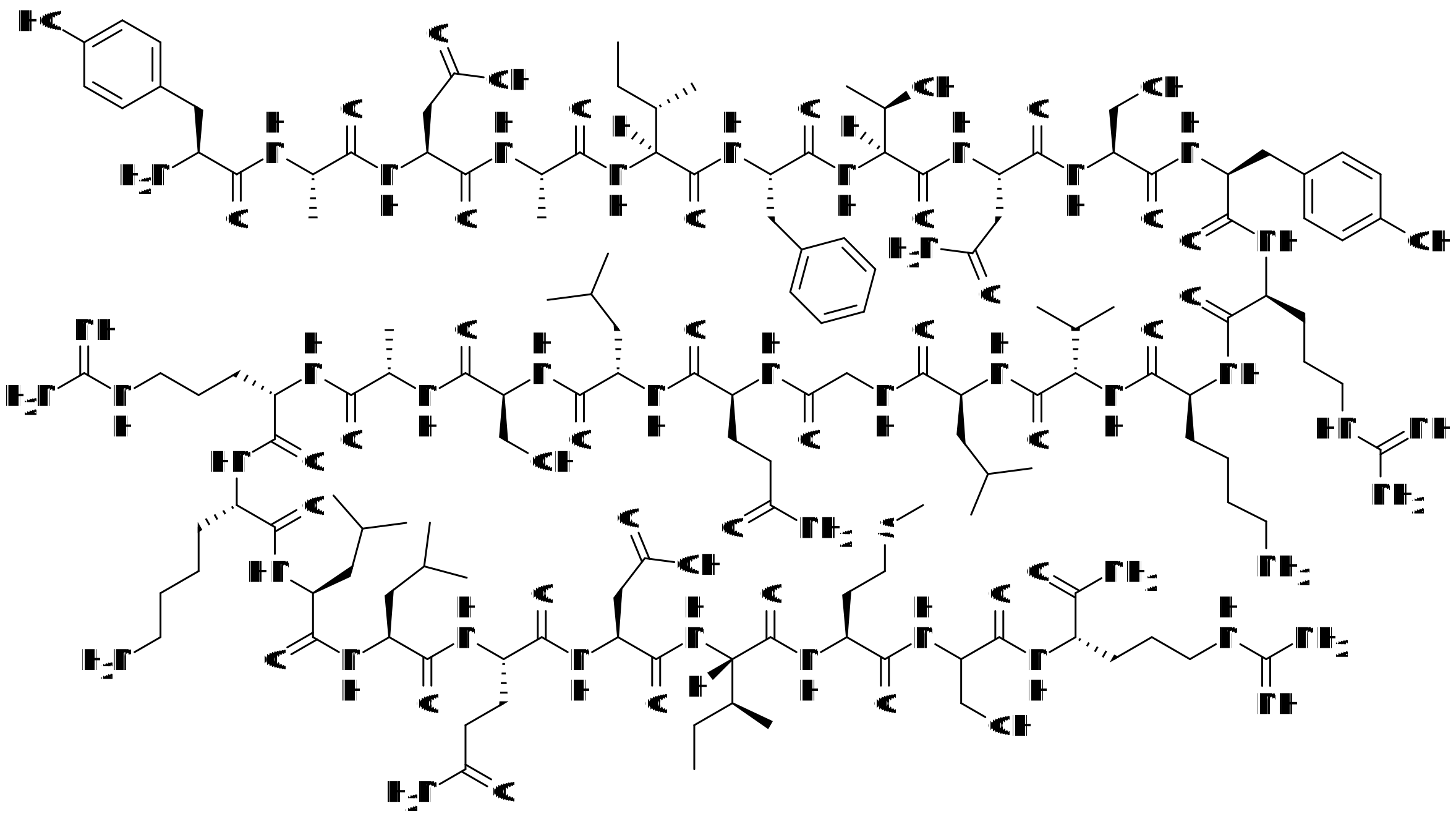
Sermorelin is a synthetic analogue of residues 1–29 of human GHRH that activates the GHRHR on pituitary somatotrophs to evoke physiologic, pulsatile release of endogenous growth hormone (GH) while preserving negative feedback by somatostatin and IGF-1.
Sermorelin (GRF(1-29)NH₂) corresponds to the N-terminal 29 residues of the 44-residue native human GHRH and is the shortest fragment that retains the full intrinsic agonist activity of the parent molecule (Prakash & Goa, BioDrugs 1999). After subcutaneous administration, peak plasma concentrations occur within ~5–20 minutes, but the peptide is rapidly inactivated in plasma — predominantly by dipeptidyl peptidase-IV (DPP-IV), which cleaves the N-terminal Tyr-Ala dipeptide to yield the inactive GRF(3-29)NH₂ — giving an elimination half-life of roughly 11–12 minutes. Despite this brief residence, transient GHRHR engagement is sufficient to trigger a discrete GH pulse with a pharmacodynamic effect lasting 1–2 hours. Because the stimulus is pulsatile and the response remains under endogenous IGF-1 and somatostatin feedback, sermorelin is mechanistically distinct from exogenous recombinant human growth hormone (somatropin), which directly raises systemic GH without preserving pulsatility, and from longer-acting GHRH analogues such as tesamorelin (a stabilised GHRH(1-44) with N-terminal trans-3-hexenoyl protection) and CJC-1295 (a DPP-IV-resistant GHRH(1-29) with optional drug-affinity-complex / DAC conjugation that extends half-life from minutes to days).