Synthetic Heptapeptide (MEHFPGP, Cognitive-Nootropic Class — Neuroprotective Research Peptide)

Semax

Also Known As: MEHFPGP, ACTH(4-7)-Pro-Gly-Pro, ACTH(4-10) analogue, Met-Glu-His-Phe-Pro-Gly-Pro, Семакс

Semax (MEHFPGP) is a synthetic heptapeptide developed in the 1980s at the Institute of Molecular Genetics of the Russian Academy of Sciences (Ashmarin / Myasoedov groups) as a stabilised analogue of the ACTH(4-7) tetrapeptide motif (Met-Glu-His-Phe). The C-terminal Pro-Gly-Pro extension confers proteolytic stability and enables intranasal nose-to-brain delivery. Despite its ACTH-fragment ancestry, Semax is NOT a melanocortin agonist — the peptide lacks the Arg-Trp dipeptide essential for binding to MC1R/MC4R/MC5R; some studies report only competitive antagonism at MC4/MC5. Semax is approved by the Russian Federation (Минздрав РФ / Roszdravnadzor) and was added to the Russian List of Vital and Essential Drugs (ЖНВЛП / ZHVNLP) on 7 December 2011 — registered as a 1% intranasal spray for acute ischaemic stroke and transient ischaemic attack, and as a 0.1% intranasal spray for memory and cognitive disorders, encephalopathy, optic-nerve neuropathy and minimal brain dysfunction in children ≥7 years. Semax is NOT FDA-approved, NOT EMA-approved, NOT MHRA-approved and NOT TGA-approved. A systematic ClinicalTrials.gov v2 API query on 1 May 2026 for "semax" returned zero registered studies (zero ClinicalTrials.gov NCT IDs, queried 2026-05-01); the pattern is consistent with pre-FDAAA Russian RCTs that were never registered with ClinicalTrials.gov. Plasma half-life after intranasal administration is in the minutes range, while CNS pharmacodynamic effects persist for hours-to-days through neurotrophin transcriptional remodeling (BDNF, NGF). For athletes under WADA-Code jurisdiction, Semax is NOT named on the 2026 WADA Prohibited List, but outside Russia it falls under WADA Class S0 (Non-Approved Substances) because it lacks any marketing authorisation in those jurisdictions.

Identity & Chemistry

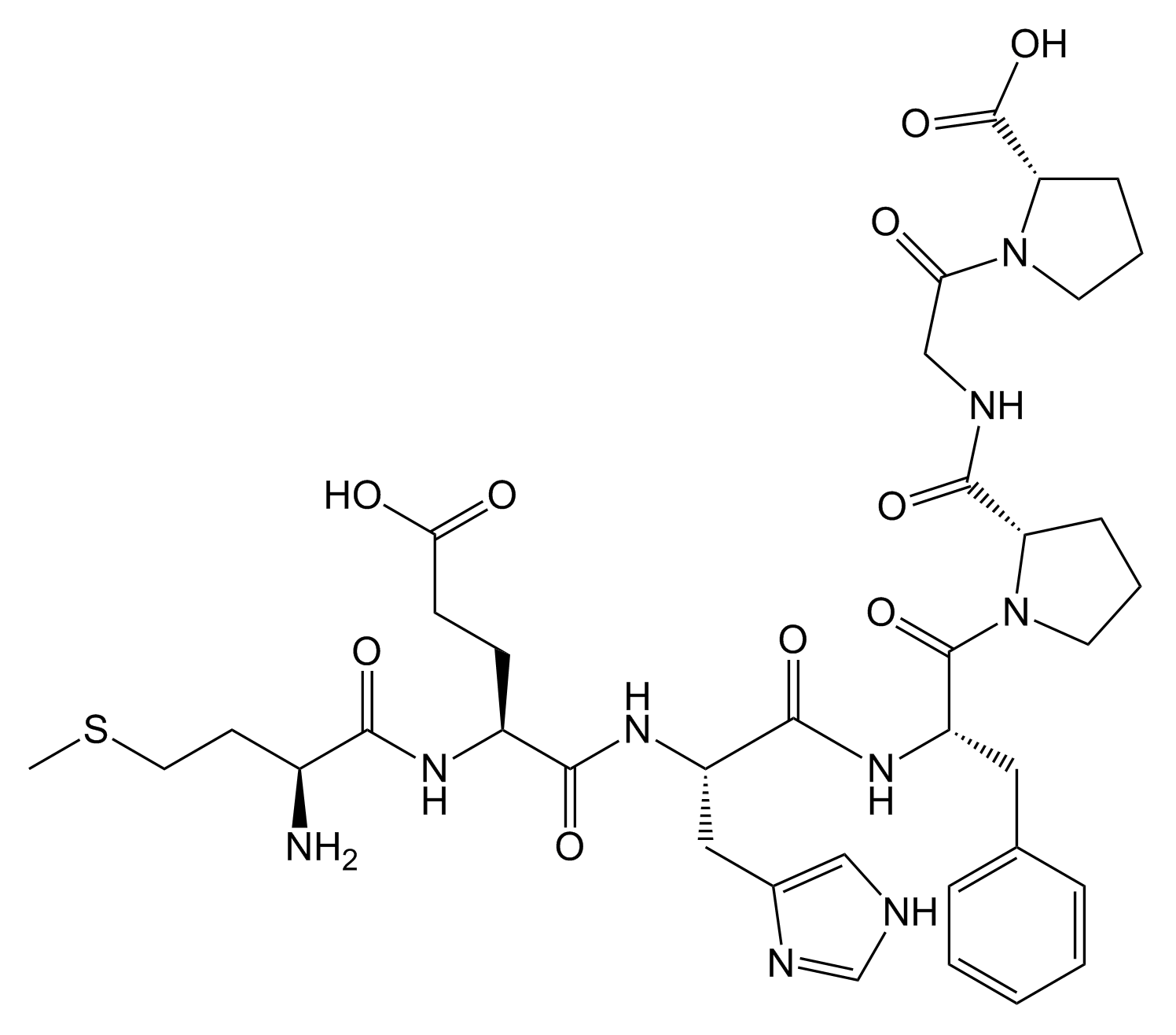
Chemical structure of Semax (Met-Glu-His-Phe-Pro-Gly-Pro), a heptapeptide stabilised analogue of the ACTH(4-7) fragment showing the methionine-glutamate-histidine-phenylalanine-proline-glycine-proline backbone.
Image credit: Meodipt, via Wikimedia Commons (released into the public domain by the author, 2012) · Public Domain
Amino Acid Sequence
H-Met-Glu-His-Phe-Pro-Gly-Pro-OH (MEHFPGP, 7 amino acids; stabilised analogue of the ACTH(4-7) tetrapeptide motif MEHF with a C-terminal Pro-Gly-Pro extension; Semax retains the ACTH(4-7) cognitive/neurotrophic motif and replaces the Arg-Trp-Gly C-terminus of ACTH(4-10) with Pro-Gly-Pro for proteolytic stability)
Molecular Formula
C₃₇H₅₁N₉O₁₀S
Molecular Weight
813.92 g·mol⁻¹ (≈ 813.9 Da, free base; PubChem CID 122178)
CAS Number
80714-61-0 (free base)
PubChem CID
122178
IUPAC Name
L-methionyl-L-α-glutamyl-L-histidyl-L-phenylalanyl-L-prolylglycyl-L-proline
Solubility
Freely soluble in water; the Russian clinical product is supplied as an aqueous 0.1% or 1% solution administered intranasally. Insoluble in most organic solvents.
Storage
Lyophilised peptide: store at −20 °C protected from light and moisture (long-term). Reconstituted solutions: store at 2–8 °C, short-term working stability per supplier certificate of analysis; for research use only.

Mechanism of Action

Semax is a stabilised heptapeptide analogue of the ACTH(4-7) fragment that exerts neuroprotective and nootropic effects primarily through upregulation of BDNF and NGF in the hippocampus and frontal cortex, with downstream activation of the TrkB / TrkA receptor pathways. Studies report additional mechanisms: inhibition of enkephalin-degrading enzymes, Cu(II) chelation with protection against Aβ-Cu-driven oxidative stress, and immunomodulatory cytokine remodeling after cerebral ischaemia. Despite its ACTH-fragment ancestry, Semax is NOT a melanocortin agonist and does NOT stimulate cortisol release or the HPA axis — studies report at most competitive antagonism at MC4/MC5.

Studies report that the C-terminal Pro-Gly-Pro extension extends the proteolytic half-life enough for intranasal nose-to-brain delivery to yield reproducible behavioural effects. The seminal Dolotov 2006 paper (PMID 16996037) showed in rats that a single Semax dose (50 µg/kg s.c.) produced a 1.4-fold increase in hippocampal BDNF protein and a 1.6-fold increase in TrkB tyrosine phosphorylation within hours, paralleled by improvement in conditioned-avoidance learning. The Stavchansky / Shadrina 2009 work (PMID 19633950) demonstrated activated transcription of NGF, BDNF, NT-3, TrkA, TrkB, TrkC and p75NTR in rat frontal cortex following permanent MCAO. In vivo, intranasal Semax produces a transient plasma exposure (minutes) but a multi-hour to multi-day transcriptional response in the hippocampus, frontal cortex and cerebellum: BDNF, NGF and NT-3 mRNAs and their cognate Trk receptors are upregulated, while pro-inflammatory cytokine transcripts and apoptotic-pathway transcripts are dampened in penumbral cortex. The C-terminal Pro-Gly-Pro fragment is itself bioactive and reproduces a substantial portion of the central transcriptional signature, suggesting Semax acts in part as a Pro-Gly-Pro pro-peptide. Despite the ACTH-fragment ancestry, Semax is NOT a melanocortin-receptor agonist and does NOT stimulate the hypothalamic-pituitary-adrenal axis — a critical disambiguation versus full-length ACTH (corticotropin) pharmacology. Studies report additional mechanisms such as inhibition of enkephalin-degrading enzymes and Cu(II) chelation with protection against Aβ-Cu-driven oxidative stress — these Cu(II) findings come from the Italian La Mendola / Tomasello lineage and are published entirely outside the Ashmarin / Myasoedov RAMS network.
Molecular Targets

  • TrkB (BDNF cognate receptor) — studies report that Semax raises hippocampal BDNF mRNA / protein and TrkB tyrosine phosphorylation 1.4–1.6-fold within hours of administration (Dolotov 2006, PMID 16996037)
  • TrkA (NGF cognate receptor) — studies report upregulation of NGF in frontal cortex and hippocampus during cerebral ischaemia (Stavchansky / Shadrina 2009/2011, PMID 19633950)
  • Enkephalin-degrading peptidases (human serum, in vitro) — Semax and Selank inhibit aminopeptidases, carboxypeptidase H and ACE; IC₅₀ ≈ 10 μM (Kost 2001, PMID 11443939)
  • Cu(II) / Aβ aggregation (in vitro) — studies report that Semax extracts Cu(II) from Aβ:Cu(II) complexes, attenuates Cu-catalysed ROS production and is cytoprotective in oxidative-stress assays (La Mendola 2014; Tomasello 2025) — independent Italian research lineage outside the Russian network
  • Melanocortin receptors (MC4/MC5) — competitive antagonism reported, NOT agonism; Semax does NOT stimulate cortisol release from the adrenal cortex
  • Opioid system (μ/κ) — Semax blocks the opioid form of stress-induced analgesia in rats; effect attenuated by naloxone (Manchenko 2010)

Signaling Pathways

  • BDNF/NGF transcription → MAPK/ERK and PI3K/AKT signalling pathways → neuronal survival and synaptic plasticity
  • CREB-mediated transcription of BDNF/NGF and immediate-early genes after focal cerebral ischaemia
  • Cytokine / immune-gene transcriptional remodelling in penumbral tissue after permanent MCAO (Filippenkov / Dergunova et al.)
  • Enkephalinase inhibition → increased availability of endogenous enkephalins → opioidergic modulation
  • Cu(II) sequestration → reduction of Aβ-driven oxidative stress in Alzheimer-disease model systems (in vitro)
  • PK/PD divergence: plasma half-life minutes (intranasal) while CNS effects persist for hours-to-days — consistent with action mediated via neurotrophin transcriptional remodeling rather than direct receptor occupancy

Research Applications

The published evidence base spans Russian clinical trials in acute ischaemic stroke (Skvortsova 1997, Gusev/Skvortsova 2018 PROFIT post-marketing study), preclinical BDNF/NGF upregulation in rats (Dolotov 2006, Shadrina 2010), Cu(II) / Aβ chelation in vitro (La Mendola 2014, Tomasello 2025), optic-nerve disease studies (Polunin 2000) and small Russian healthy-volunteer studies of attention and short-term memory. The Italian La Mendola / Tomasello lineage and the independent Cognitive Vitality monograph from the Alzheimer's Drug Discovery Foundation are published outside the Ashmarin / Myasoedov RAMS network.

Acute ischaemic stroke — Russian clinical trials

Phase IV

Studies report in 30 patients with acute hemispheric ischaemic stroke (Skvortsova 1997, PMID 11517472) faster regression of cerebral and motor deficits when Semax 1% intranasal was added to standard care vs. an 80-patient conventional-therapy control group. The Gusev/Skvortsova 2018 post-marketing PROFIT study in 110 post-stroke patients reported elevated plasma BDNF and improved Barthel Index and MRC motor scores under 6,000 µg/day intranasal across two 10-day courses. Editorial caveat: all positive trials are single-centre Russian-language publications; independent Cochrane and Western umbrella reviews of acute-stroke neuroprotection have NOT validated the signal; Western practitioners regard the evidence base as low-to-very-low quality.

— Skvortsova et al. 1997/2008, Zh Nevrol Psikhiatr (PMID 11517472); Gusev/Skvortsova et al. 2018, Zh Nevrol Psikhiatr 118(3-2):61–68 (PMID 29798983)

BDNF / NGF upregulation — rat hippocampus, in vivo / in vitro

in vivo

Studies report under a single Semax dose (50 µg/kg s.c.) a 1.4-fold increase in BDNF protein and a 1.6-fold increase in TrkB tyrosine phosphorylation in rat hippocampus, paralleled by improvement in conditioned-avoidance learning paradigms (Dolotov 2006). Stavchansky / Shadrina 2009 demonstrated activated transcription of NGF, BDNF, NT-3, TrkA, TrkB, TrkC and p75NTR in rat frontal cortex following permanent MCAO.

— Dolotov et al. 2006, Brain Res 1117(1):54–60 (PMID 16996037); Shadrina et al. 2010, Cell Mol Neurobiol 30(1):71–79 (PMID 19633950)

Optic-nerve neuropathy / glaucomatous optic atrophy — Russian comparison study

observational

Studies report under Semax intranasal drops vs. endonasal electrophoresis vs. control in patients with vascular, toxic-allergic, inflammatory and partial-atrophy optic-nerve disease an improvement in visual acuity, total visual-field area, electric sensitivity and conductivity of the optic nerve and colour vision; the intranasal route was most effective (Polunin 2000, PMID 10741256).

— Polunin et al. 2000, Vestn Oftalmol 116(1):15–18 (PMID 10741256)

Alzheimer-relevant Cu(II) / Aβ chelation — independent Italian research, in vitro

in vitro

Studies report in the Italian La Mendola / Tomasello lineage (published entirely outside the Ashmarin / Myasoedov RAMS network) that Semax extracts Cu(II) from Aβ:Cu(II) complexes, attenuates Cu-catalysed ROS production and is cytoprotective in oxidative-stress assays (La Mendola 2014, J Inorg Biochem; Tomasello 2025, Bioinorg Chem Appl). This is the most important independent replication outside the Russian research lineage.

— La Mendola et al. 2014, J Inorg Biochem 141:33–43; Tomasello et al. 2025, Bioinorg Chem Appl 2025:4226220

Enkephalinase inhibition — human serum, in vitro

in vitro

Studies report that Semax and Selank competitively inhibit enkephalin-degrading enzymes (aminopeptidases, carboxypeptidase H, ACE) in human serum, with IC₅₀ ≈ 10 μM for Semax — the only directly biochemically measured mechanism beyond neurotrophin transcriptional remodeling. This enkephalinase inhibition is interpreted as a contributor to the opioidergic modulation signal.

— Kost et al. 2001, Russ J Bioorg Chem 27(3):156–159 (PMID 11443939)

Clinical Status

Regulatory Status
Semax is NOT FDA-approved, NOT EMA-approved, NOT MHRA-approved, NOT TGA-approved and NOT approved by Health Canada for any clinical indication. The Russian Ministry of Health (Минздрав РФ / Roszdravnadzor) added Semax to the Russian List of Vital and Essential Drugs (ЖНВЛП / ZHVNLP) on 7 December 2011 — registered as a 1% intranasal spray for acute ischaemic stroke, transient ischaemic attack and other acute cerebral ischaemic events, and as a 0.1% intranasal spray for memory and cognitive disorders, encephalopathy, optic-nerve disease and minimal brain dysfunction in children ≥7 years. This Russian registration is a Russian-only regulatory action and is NOT equivalent to Western marketing authorisation. A systematic ClinicalTrials.gov v2 API query on 1 May 2026 for "semax" returned zero registered studies (zero ClinicalTrials.gov NCT IDs, queried 2026-05-01); the pattern is consistent with pre-FDAAA Russian RCTs that were never registered with ClinicalTrials.gov. The substance has a UNII identifier (I5FAL2585H) in the FDA Global Substance Registration System, but UNII assignment does NOT imply FDA review or approval. ATC classification: N06BX (other psychostimulants and nootropics). For athletes under WADA-Code jurisdiction, Semax is NOT named on the 2026 WADA Prohibited List and NOT on the 2026 Monitoring Program; outside Russia, however, WADA Class S0 (Non-Approved Substances) applies because Semax lacks any marketing authorisation in those jurisdictions — Russian registration alone does NOT lift the S0 applicability outside Russia.
Show more
Highest Trial Phase
Highest published phase: Phase IV / post-marketing in Russia (Gusev/Skvortsova 2018 PROFIT study). NO Phase 1/2/3 registration in any Western jurisdiction. Russian marketing authorisation since the 1990s; ZHVNLP listing on 7 December 2011.
Sponsor
Institute of Molecular Genetics, Russian Academy of Sciences (Ashmarin / Myasoedov groups) and Innopharma JSC (ИНПЦ "Пептоген" / Peptogen); commercial distribution by Pharmstandard and other Russian pharmaceutical distributors.

Safety Profile

Observed in research settings

Studies report that adverse events in Russian clinical use are uncommon and predominantly mild and route-related — observed in research and Russian post-marketing settings. There is NO Western long-term pharmacovigilance dataset and NO controlled long-term safety trial in Western populations. Editorial caveat: the majority of the safety dataset comes from the Myasoedov / Ashmarin / RAMS lineage and has NOT been independently audited externally.

Adverse Events Reported in Studies

  • Local nasal irritation / mild rhinorrhoea — most-frequently reported event with chronic intranasal dosing; typically transient (Russian product information; Skvortsova 1997)
  • Headache — reported in a minority of post-stroke and cognitive-indication patients during initial dosing
  • Sleep disturbance / mild insomnia — particularly with evening dosing; consistent with the noradrenergic / dopaminergic activation described in animal models
  • Mild, transient blood-pressure changes — described in small early-phase studies; no consistent direction of change
  • Hypersensitivity — rare; standard contraindication in patients with prior reaction to peptide products (Russian Minzdrav package insert)

Serious Adverse Events

  • Human data gap: NO Western long-term pharmacovigilance dataset exists; all published safety data come from Russian studies and post-marketing reports — observed in research settings
  • Editorial safety flag: the safety evidence base is dominated by the Myasoedov / Ashmarin / RAMS lineage and has NOT been independently audited externally
  • Pediatric data: Russian regulatory approval includes children ≥5–7 years for minimal brain dysfunction (0.1% intranasal); NO Western pediatric trials exist
  • Reproductive and lactation safety: no human reproductive-toxicity data publicly available
  • Drug interactions: not systematically evaluated in humans (MAOIs, SSRIs, opioids, anticoagulants)

References

  1. Ashmarin IP, Nezavibatko VN, Myasoedov NF, et al. A nootropic adrenocorticotropin analog 4-10-Semax (15 years' experience in design and study) Zh Vyssh Nerv Deyat 1997;47(2):420–430. 1997 .

  2. Skvortsova VI, Stakhovskaya LV, Gubsky LV, et al. Effectiveness of semax in acute period of hemispheric ischemic stroke (a clinical and electrophysiological study) Zh Nevrol Psikhiatr Im SS Korsakova 1997 (2008 reissue). 2008 .

  3. Gusev EI, Martynov MY, Kostenko EV, et al. The efficacy of semax in the treatment of patients at different stages of ischemic stroke Zh Nevrol Psikhiatr Im SS Korsakova 2018;118(3-2):61–68. 2018 .

  4. Dolotov OV, Karpenko EA, Inozemtseva LS, et al. Semax, an analog of ACTH(4-10) with cognitive effects, regulates BDNF and trkB expression in the rat hippocampus Brain Res 2006;1117(1):54–60. 2006 .

  5. Shadrina M, Filippenkov IB, Stavchansky VV, et al. Semax and Pro-Gly-Pro activate the transcription of neurotrophins and their receptor genes after cerebral ischemia Cell Mol Neurobiol 2010;30(1):71–79. 2010 .

  6. Polunin GS, Nurieva SM, Bayandin DL, et al. Evaluation of therapeutic effect of new Russian drug semax in optic nerve disease Vestn Oftalmol 2000;116(1):15–18. 2000 .

  7. La Mendola D, Giacomelli C, Rizzarelli E Semax, an ACTH 4-10 peptide analog with high affinity for copper(II) ion and protective ability against metal-induced cell toxicity J Inorg Biochem 2014;141:33–43. 2014 .

  8. Tomasello MF, La Mendola D, Naletova I, et al. Semax, a copper-chelator peptide, decreases the Cu(II)-catalyzed ROS production and cytotoxicity of Aβ by metal-ion stripping and redox silencing Bioinorg Chem Appl 2025;2025:4226220. 2025 .

  9. Kost NV, Sokolov OYu, Gabaeva MV, Grivennikov IA, Andreeva LA, Myasoedov NF, Zozulya AA Semax and Selank Inhibit the Enkephalin-Degrading Enzymes from Human Serum Russ J Bioorg Chem 2001;27(3):156–159. 2001 .

  10. Alzheimer's Drug Discovery Foundation, Cognitive Vitality team Semax — Cognitive Vitality for Researchers (independent Western monograph) Alzheimer's Drug Discovery Foundation. 2020 .

  11. World Anti-Doping Agency The 2026 Prohibited List — International Standard WADA, effective 1 January 2026. 2026 .

Frequently Asked Questions

What is the difference between Semax and Selank?
Both are heptapeptides developed at the same Russian institute (Ashmarin / Myasoedov, RAMS) but have different sequences and different primary effects. Semax is Met-Glu-His-Phe-Pro-Gly-Pro (MEHFPGP), derived from ACTH(4-7), and is studied primarily for neuroprotective and nootropic activity via BDNF/NGF upregulation. Selank is Thr-Lys-Pro-Arg-Pro-Gly-Pro (TKPRPGP), derived from the immunopeptide tuftsin, and is studied primarily for anxiolytic activity via GABAergic modulation. Both share the C-terminal Pro-Gly-Pro stabilising motif, but the N-terminal pharmacophores differ entirely; the two compounds are commonly conflated in non-academic sources but are mechanistically and clinically distinct.
Is Semax FDA- or EMA-approved?
No. Semax is NOT approved by the FDA, NOT approved by the EMA, NOT approved by the MHRA, NOT approved by the TGA, NOT approved by Health Canada or by any Western regulatory agency. It is approved by the Russian Ministry of Health (Минздрав) and listed on the Russian List of Vital and Essential Drugs (ZHVNLP, added 7 December 2011). A ClinicalTrials.gov v2 API query on 1 May 2026 returned zero registered studies. The substance has a UNII (I5FAL2585H) in the FDA Global Substance Registration System, but UNII assignment is purely a cataloguing operation and does NOT imply FDA review or approval.
Is Semax a melanocortin agonist (like α-MSH or PT-141)?
No. Although Semax derives from the ACTH(4-10) sequence, the peptide retains only the ACTH(4-7) motif (M-E-H-F) and replaces the Arg-Trp-Gly C-terminus — including the Arg-Trp dipeptide essential for melanocortin-receptor binding — with Pro-Gly-Pro. As a result, Semax does NOT stimulate cortisol release, does NOT pigment the skin and does NOT behave as a melanocortin agonist. Some studies report a competitive antagonist effect at MC4/MC5; clinically the peptide does NOT engage the hypothalamic-pituitary-adrenal axis the way full-length ACTH (corticotropin) does.
How does Semax work mechanistically?
The dominant evidence is for upregulation of BDNF and NGF transcripts and protein in the hippocampus and frontal cortex, with downstream activation of the TrkB / TrkA receptors and the MAPK/ERK and PI3K/AKT survival pathways. Studies report additional actions: opioidergic modulation (blockade of opioid stress-induced analgesia), inhibition of enkephalin-degrading enzymes (Kost 2001, IC₅₀ ≈ 10 μM), dopaminergic / serotonergic activation, anti-inflammatory cytokine remodeling after cerebral ischaemia, and Cu(II) chelation that attenuates Aβ-Cu-driven oxidative stress in artificial-membrane Alzheimer-disease models (La Mendola 2014, Tomasello 2025).
Does Semax improve cognitive performance in healthy adults?
The healthy-volunteer dataset is small and predominantly Russian-language. Studies report improvements in attention and short-term memory and EEG signatures consistent with neuroprotective drugs at intranasal doses of 250–1,000 µg/kg. However, there is NO large, independently-replicated Western trial in healthy adults. Independent Western reviewers (e.g. the Alzheimer's Drug Discovery Foundation Cognitive Vitality monograph) characterise the cognitive-enhancement evidence in healthy adults as preliminary and underpowered.
What is the evidence base for Semax in acute ischaemic stroke?
Semax 1% intranasal is registered for acute ischaemic stroke in Russia on the basis of multiple Russian-language clinical trials (Skvortsova 1997, PMID 11517472; Gusev/Skvortsova 2018 PROFIT post-marketing study, PMID 29798983) showing reduced disability scores, raised plasma BDNF and improved Barthel Index when added to standard care. Important caveat: these trials are single-centre Russian-language publications, and independent Cochrane / Western umbrella reviews of acute-stroke neuroprotection have NOT validated the signal. The evidence base is therefore best characterised as suggestive but low-quality by Western standards, and is NOT the basis for FDA or EMA approval.
What is Semax's WADA status?
Semax is NOT named on the 2026 WADA Prohibited List and NOT on the 2026 Monitoring Program. However, athletes under WADA-Code jurisdiction must consider that WADA Class S0 (Non-Approved Substances) applies outside Russia because Semax lacks any marketing authorisation in those jurisdictions. Russian registration alone does NOT lift the S0 applicability outside Russia. Athletes should consult their anti-doping authority before any use.