Endogenous peptide hormone (KISS1 gene product) and investigational reproductive-endocrine therapeutic — master upstream regulator of the GnRH pulse generator

Kisspeptin

Also Known As: Kisspeptin-54, KP-54, Kisspeptin-10, KP-10, Metastin, Metastatin, KiSS-1 peptide, Kisspeptin-13, KP-13, Kisspeptin-14, KP-14

Kisspeptin is an endogenous human peptide hormone encoded by the KISS1 gene on chromosome 1q32, and simultaneously an investigational therapeutic. "Kisspeptin" is not a single molecule but a family of C-terminally amidated cleavage products of the 145-amino-acid prepro-protein (UniProt Q15726): the four characterised endogenous bioactive forms — KP-54 (residues 68–121, originally named metastin), KP-14, KP-13 and KP-10 (residues 112–121) — all share the C-terminal RF-amide decapeptide YNWNSFGLRF-NH₂ that binds the kisspeptin receptor (KISS1R; legacy names GPR54, AXOR12, hOT7T175) with low-nanomolar affinity. Studies report that hypothalamic kisspeptin neurons project onto GnRH neurons, where kisspeptin binding to KISS1R depolarises GnRH neurons via Gαq/11–PLC–IP₃–Ca²⁺ signalling, triggering pulsatile GnRH release and downstream pituitary LH/FSH secretion. Loss-of-function mutations in KISS1 (de Roux 2003 PNAS; Topaloglu 2012 NEJM) or KISS1R (Seminara 2003 NEJM) abolish puberty and cause normosmic isolated hypogonadotropic hypogonadism (nIHH). Kisspeptin is NOT FDA-approved, NOT EMA-approved, NOT MHRA-approved, NOT PMDA-approved and NOT NMPA-approved for any clinical indication — as of May 2026 it is investigational only. Four registered trials have been verified against the ClinicalTrials.gov v2 API on 1 May 2026: NCT01667406 (Imperial College London IVF triggering Phase 2; completed), NCT02081924 (Imperial College London sustained administration), NCT01952782 (MGH IV KP-112-121 in HH; completed) and NCT05896293 (MGH pulsatile SC in IHH; recruiting). In the IVF setting, the mechanism-of-action safety innovation is that a single SC dose of KP-54 (typically 6.4–12.8 nmol/kg) triggers oocyte maturation in over 90% of women WITHOUT any moderate or severe ovarian hyperstimulation syndrome (OHSS) cases — even in high-risk high-AMH responders (Jayasena 2014 JCI; Abbara 2015 JCEM). Kisspeptin is NOT named on the 2026 WADA Prohibited List, but mechanistically adjacent to S2 (Hormone & Metabolic Modulators) via the GnRH axis; athletes should consult WADA / their national anti-doping organisation before any use.

Identity & Chemistry

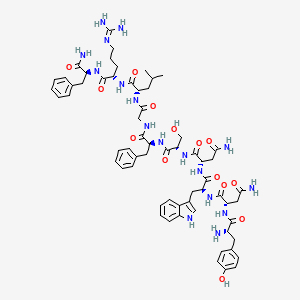
Chemical structure of kisspeptin-10 (KP-10), the C-terminally amidated decapeptide YNWNSFGLRF-NH₂. KP-10 represents the active C-terminal core conserved in all longer kisspeptin isoforms (KP-13, KP-14, KP-54/metastin), all of which bind and activate the kisspeptin receptor KISS1R / GPR54.
Image credit: Structure data from PubChem CID 25240297 (US National Library of Medicine, NIH). KP-10 is the bioactive C-terminal decapeptide shared by KP-13, KP-14 and KP-54. · Public Domain
Amino Acid Sequence
KP-10: H-Tyr-Asn-Trp-Asn-Ser-Phe-Gly-Leu-Arg-Phe-NH₂ (YNWNSFGLRF-NH₂, 10 amino acids; the C-terminally amidated decapeptide that represents the minimum bioactive sequence required to bind and activate KISS1R) | KP-54: 54-aa C-terminally amidated peptide corresponding to residues 68–121 of human prepro-KISS1 (UniProt Q15726), terminating in the same YNWNSFGLRF-NH₂ C-terminal motif as KP-10. KP-13 (residues 109–121) and KP-14 (residues 108–121) are additional endogenous cleavage products that share the identical C-terminal RF-amide pharmacophore.
Molecular Formula
C₆₃H₈₃N₁₇O₁₄ (KP-10; PubChem 25240297) + C₂₅₈H₄₀₁N₇₉O₇₈ (KP-54 / metastin; PubChem 71306396)
Molecular Weight
1302.45 Da (KP-10, free base) + ~5857.4 Da (KP-54 / metastin, free base average)
CAS Number
374675-21-5 (KP-10) + 374683-24-6 (KP-54; also cited by some vendors as 338458-53-0 — both refer to the KP-54 free base)
DrugBank ID
DB04929
IUPAC Name
L-tyrosyl-L-asparaginyl-L-tryptophyl-L-asparaginyl-L-seryl-L-phenylalanyl-glycyl-L-leucyl-L-arginyl-L-phenylalaninamide (KP-10; the bioactive decapeptide whose sequence is conserved at the C-terminus of all longer kisspeptin isoforms)
Solubility
KP-10 and KP-54 are freely soluble in sterile water or sterile bacteriostatic saline (≥1 mg/mL for KP-10). Insoluble in most organic solvents.
Storage
Lyophilised peptide: store at −20 °C protected from light and moisture (long-term). Reconstituted aliquots: short-term at 2–8 °C, longer-term at −80 °C; avoid freeze-thaw cycles. Clinical-trial KP-54 (Imperial College London IVF programme) was administered as a sterile subcutaneous bolus reconstituted from a GMP-grade lyophilisate.

Mechanism of Action

Kisspeptin is the master upstream regulator of the GnRH pulse generator. Studies report that hypothalamic kisspeptin neurons project onto GnRH neurons, where kisspeptin binding to KISS1R / GPR54 depolarises GnRH neurons via Gαq/11–PLCβ–IP₃–intracellular Ca²⁺ signalling and triggers pulsatile GnRH release into the pituitary portal circulation. Downstream, GnRH drives LH and FSH secretion from the anterior-pituitary gonadotropes, with ovarian or testicular steroidogenic responses. Loss-of-function mutations in KISS1 or KISS1R abolish puberty and cause normosmic isolated hypogonadotropic hypogonadism.

Studies report that the two anatomically and functionally distinct hypothalamic kisspeptin neuron populations do OPPOSITE jobs in the reproductive cycle. (1) The anteroventral periventricular nucleus / preoptic area (AVPV/POA) kisspeptin neurons are sexually dimorphic — far more numerous in females than males — and mediate the estrogen-positive feedback that drives the pre-ovulatory LH surge. Rising estradiol in the late follicular phase activates AVPV kisspeptin neurons via ERα, producing a coordinated burst of kisspeptin release onto GnRH neurons and triggering ovulation. (2) The arcuate-nucleus kisspeptin neurons co-express Neurokinin B and Dynorphin and are therefore termed KNDy neurons. The KNDy population is the cellular substrate of the GnRH pulse generator: synchronised KNDy bursts (every 30–120 min) drive pulsatile GnRH release and mediate estradiol/testosterone-negative feedback. Functional segregation: AVPV ⇒ surge / ovulation; arcuate-KNDy ⇒ pulsatility / negative feedback. Therapeutic KP-54 administration in IVF protocols mimics the AVPV-driven LH surge mechanism — the mechanistic reason it triggers oocyte maturation WITHOUT the supra-physiologic, prolonged LH/hCG-receptor stimulation that drives ovarian hyperstimulation syndrome (OHSS) when hCG is used as the trigger. This mechanism-of-action safety differentiation is the central advantage of the KP-54 IVF trigger over hCG. Studies report Ki values ~1.45 nM for KP-54 at human GPR54/KISS1R (Kotani 2001) and plasma half-lives of ~4 min for KP-10 versus ~28 min for KP-54 (Dhillo 2005). Loss-of-function mutations in KISS1 (Topaloglu 2012, NEJM) or KISS1R / GPR54 (de Roux 2003 PNAS; Seminara 2003 NEJM) cause an identical clinical phenotype — failure of puberty and infertility — because no upstream signal reaches the GnRH neuron.

Molecular Targets

  • KISS1R / GPR54 / AXOR12 / hOT7T175 — class A G-protein-coupled receptor (rhodopsin-like), primarily Gαq/11-coupled; locus 19p13.3; Ki ≈ 1.45 nM for human KP-54 (Kotani 2001, PMID 11457843)
  • GnRH neuron (downstream) — studies report kisspeptin-mediated depolarisation and pulsatile GnRH release into the pituitary portal circulation, the proximal event of puberty and the reproductive axis
  • Pituitary gonadotropes (two steps downstream) — LH and FSH secretion; KP-54 IV bolus in healthy men produces dose-dependent LH/FSH/testosterone rises (Dhillo 2005, PMID 16174713)
  • AVPV / preoptic kisspeptin neurons — sexually dimorphic, mediate estrogen-positive feedback that drives the pre-ovulatory LH surge / ovulation
  • Arcuate KNDy neurons (Kisspeptin/Neurokinin B/Dynorphin co-expressing) — cellular substrate of the GnRH pulse generator; synchronised KNDy bursts (every 30–120 min) drive pulsatile GnRH release and estradiol/testosterone-negative feedback
  • KISS1 / KISS1R gene axis as a metastasis-suppressor (oncology) — studies report that the KISS1/KISS1R axis paradoxically suppresses metastasis in melanoma, breast, ovarian and pancreatic cancer cell lines while being upregulated during normal placentation (Lee 1996, PMID 8944003)

Signaling Pathways

  • KISS1R → Gαq/11 → phospholipase C-β (PLCβ) → IP₃ + DAG → intracellular Ca²⁺ release → GnRH neuron depolarisation → pulsatile GnRH release
  • ERK1/2 (MAPK) and p38 MAPK activation; modest β-arrestin recruitment (less than other RF-amide GPCRs)
  • GnRH → anterior pituitary gonadotropes → LH (and FSH) → ovarian theca/granulosa or testicular Leydig/Sertoli cells → estradiol/progesterone (♀) or testosterone (♂) → negative/positive hypothalamic feedback
  • AVPV-vs-arcuate functional segregation: AVPV population mediates the pre-ovulatory LH surge (estrogen-positive feedback); arcuate KNDy population drives pulsatility and negative feedback — the anatomically and functionally distinct populations do OPPOSITE jobs in the reproductive cycle
  • Plasma half-life: ~4 min for KP-10 IV bolus and ~28 min for KP-54 IV bolus — KP-54 is therefore favoured for trigger-style applications (sustained LH surge over hours), KP-10 for short-pulse mechanistic studies

Research Applications

The published evidence base spans four axes: (1) IVF triggering — three Phase 2 RCTs at Imperial College London (Jayasena 2014 JCI, Abbara 2015 JCEM, Abbara 2017 Hum Reprod) show that SC KP-54 triggers oocyte maturation in over 90% of women without moderate or severe OHSS, even in high-risk high-AMH responders; (2) hypothalamic amenorrhoea and IHH (Jayasena 2014 JCI; Mass General trials NCT01952782 + NCT05896293); (3) HSDD — Mills 2023 and Comninos 2023 JAMA Network Open randomised crossover trials show enhanced limbic activation to sexual cues; (4) KISS1 as a metastasis-suppressor gene (Lee 1996 JNCI) — the paradoxical oncology-side biology of the KISS1/KISS1R axis is a separate, active preclinical line. Studies report that the diagnostic LOF-genetics proof pair (de Roux 2003 PNAS; Seminara 2003 NEJM; Topaloglu 2012 NEJM) establishes kisspeptin signalling as essential for human puberty.

IVF triggering — Phase 2 RCTs at Imperial College London (Dhillo group)

Phase II

Studies report that a single SC bolus of KP-54 (1.6, 3.2, 6.4 or 12.8 nmol/kg) triggered oocyte maturation in over 90% of participants and resulted in 0 cases of moderate or severe OHSS — even in high-AMH high-risk responders (Jayasena 2014, JCI 124(8):3667, PMID 25036713; n=53 proof-of-concept). The Phase 2 dose-finding RCT in 60 women at high OHSS risk (Abbara 2015, JCEM 100(9):3322, PMID 26192876) confirmed: oocyte maturation in 95%, live-birth rate 45% per transfer (62% at the 9.6 nmol/kg dose), NO woman developed moderate, severe or critical OHSS at any dose. A second-dose Phase 2 RCT (Abbara 2017, Hum Reprod 32(9):1915, PMID 28854728) confirmed that a two-dose regimen further improves oocyte yield in high-risk women without inducing OHSS.

— Jayasena et al. 2014, JCI 124(8):3667 (PMID 25036713); Abbara et al. 2015, JCEM 100(9):3322 (PMID 26192876)

Hypothalamic amenorrhoea, IHH and pulsatile-axis rescue

Phase II

Studies report that SC kisspeptin restores LH pulsatility in women with hypothalamic amenorrhoea (Jayasena 2014 JCI follow-up work). Mass General trials NCT01952782 (KP-112-121 IV in HH; completed) and NCT05896293 (pulsatile SC KP-112-121 in IHH; recruiting May 2026) continue to interrogate kisspeptin as a "kick-start" of the GnRH pulse generator in patients whose endogenous pulses have failed.

— Jayasena et al. 2014; ClinicalTrials.gov NCT01952782, NCT05896293 (verified vs ClinicalTrials.gov v2 API on 2026-05-01)

Hypoactive sexual desire disorder (HSDD) — randomised crossover trials

Phase II

Studies report in Mills 2023 and Comninos 2023 (JAMA Network Open) — randomised, placebo-controlled crossover trials in men (n=32) and women with HSDD — that single IV doses of kisspeptin enhance limbic activation to sexual cues on fMRI and (in men) increase penile tumescence vs placebo. These findings open a non-hormonal central-mechanism pathway for HSDD therapeutics.

— Mills et al. 2023, JAMA Netw Open; Comninos et al. 2023, JAMA Netw Open

KISS1 / KISS1R loss-of-function genetics — human puberty biology

observational

Studies report that de Roux 2003 (PNAS 100:10972, PMID 12944565) and Seminara 2003 (NEJM 349:1614, PMID 14573733) independently identified homozygous GPR54 mutations as the genetic cause of normosmic isolated hypogonadotropic hypogonadism (nIHH). Topaloglu 2012 (NEJM 366:629, PMID 22335740) later identified the mirror-image inactivating KISS1 (ligand) mutation, completing the genetic proof that kisspeptin–KISS1R signalling is essential for human puberty.

— de Roux et al. 2003, PNAS 100:10972 (PMID 12944565); Seminara et al. 2003, NEJM 349:1614 (PMID 14573733); Topaloglu et al. 2012, NEJM 366:629 (PMID 22335740)

KISS1 as a metastasis-suppressor gene — preclinical oncology (separate research line)

in vitro

Studies report that Lee 1996 (JNCI 88:1731, PMID 8944003) originally cloned KISS1 as a melanoma metastasis-suppressor gene at Penn State Hershey. The KISS1/KISS1R axis paradoxically suppresses metastasis in melanoma, breast, ovarian and pancreatic cancer cell lines, while at the same time being upregulated in normal placentation and trophoblast invasion. The oncology-side biology is a self-contained, active preclinical line of investigation pursued separately from the reproductive-endocrine programme.

— Lee et al. 1996, JNCI 88(23):1731 (PMID 8944003)
Clinical Status

Regulatory Status
Kisspeptin is NOT FDA-approved, NOT EMA-approved, NOT MHRA-approved, NOT PMDA-approved and NOT NMPA-approved for any clinical indication — as of 1 May 2026 it is investigational only. Four registered trials were verified against the ClinicalTrials.gov v2 API on 1 May 2026: NCT01667406 (Imperial College London IVF trigger Phase 2; KP-54 SC 1.6–12.8 nmol/kg; completed October 2016; n≈175), NCT02081924 (Imperial College London sustained administration; SC kisspeptin pump 0.1/0.3/1.0 nmol/kg/h × 8 days), NCT01952782 (Mass General; IV KP-112-121 in HH; completed) and NCT05896293 (Mass General; pulsatile SC KP-112-121 × 2 weeks in IHH; recruiting). There is no industry development licence for kisspeptin as a reproductive therapeutic; academic sponsors are Imperial College London (Dhillo group), Massachusetts General Hospital (Crowley/Seminara group) and Edinburgh (Anderson group). Forbidden NCTs (verified NOT to be kisspeptin trials against the ClinicalTrials.gov database on 1 May 2026): NCT02644369 (pembrolizumab in solid tumors, University Health Network Toronto — NOT a kisspeptin trial) and NCT04537975 (C2Rx hemofiltration in COVID-19, SeaStar Medical, withdrawn December 2020 — NOT a kisspeptin trial). For athletes under WADA-Code jurisdiction: kisspeptin is NOT named on the 2026 WADA Prohibited List, but pharmacologically drives endogenous LH/FSH/testosterone release through the GnRH axis and is therefore mechanistically adjacent to S2 (Hormone & Metabolic Modulators, which lists GnRH and its agonists in male athletes); athletes should confirm current status with WADA / their National Anti-Doping Organisation before any administration.
Show more
Highest Trial Phase
Highest published phase: Phase 2 (IVF triggering, hypothalamic amenorrhoea, HSDD). NO marketing authorisation in any jurisdiction. NO registered Phase 3 trial as of 1 May 2026.
Sponsor
Academic sponsors: Imperial College London (Dhillo group; IVF trigger programme), Massachusetts General Hospital (Crowley / Seminara group; HH/IHH studies), University of Edinburgh (Anderson group; reproductive biology). NO active pharmaceutical industry development licence for kisspeptin as a reproductive therapeutic as of May 2026.
Show more

Key Clinical Trials

  • The Use of the Hormone Kisspeptin in In Vitro Fertilisation (IVF) Treatment — KP-54 SC 1.6–12.8 nmol/kg as IVF trigger (Imperial College London / Dhillo group; completed Oct 2016; n≈175)
    Phase II
    NCT01667406
  • Reproductive Hormones During Sustained Administration of Kisspeptin — SC kisspeptin pump 0.1/0.3/1.0 nmol/kg/h × 8 days in hypothalamic dysfunction (Imperial College London)
    Phase II
    NCT02081924
  • Neuropeptides in Human Reproduction — IV KP-112-121 in hypogonadotropic hypogonadism (Massachusetts General Hospital, Seminara/Crowley group; completed)
    Phase I
    NCT01952782
  • Kisspeptin Administration Subcutaneously to Patients With Idiopathic Hypogonadotropic Hypogonadism — pulsatile SC KP-112-121 × 2 weeks (Massachusetts General Hospital; recruiting May 2026)
    Phase II
    NCT05896293

Safety Profile

Observed in research settings

Studies report that kisspeptin has been generally well-tolerated across Phase 1 and Phase 2 trials, with no drug-related serious adverse events reported at therapeutic doses. The mechanism-of-action safety innovation in the IVF setting is the absence of OHSS at KP-54 trigger doses — observed in research settings; this is NOT an approved-drug adverse-event profile, and long-term and rare-event data remain limited.

Adverse Events Reported in Studies

  • Mild, transient SC injection-site reactions (erythema, discomfort) — most-frequently reported events with SC dosing in the IVF programme (Abbara 2015, Abbara 2017)
  • Transient blood-pressure drop at supra-therapeutic IV doses — observed in animal and small early human studies; clinical SC doses do NOT show this
  • No anti-kisspeptin antibody formation or hypersensitivity events in published Phase 1/2 reports through 2025
  • No excess of obstetric or neonatal complications reported in the Abbara IVF cohorts; live-birth rates and infant-health metrics comparable to standard hCG triggering, though cohort sizes are small
  • No clinically relevant drug-drug interactions identified in published Phase 1/2 trials

Serious Adverse Events

  • Data gap: NO long-term safety database for repeat exposure (e.g. chronic pulsatile SC for IHH); recruiting trials NCT05896293 / NCT02081924 will help fill this gap — observed in research settings
  • Editorial safety flag: cumulative clinical exposure (Imperial IVF programme Abbara 2014/2015/2017, n>250; Dhillo 2005 first-in-human; Jayasena hypothalamic-amenorrhoea series) is smaller than that of an approved drug; rare-event safety signals cannot yet be excluded
  • Pregnancy and lactation: no human reproductive-toxicity data publicly available outside the IVF-trigger context
  • Pediatric data: no studies in children published
  • Anti-kisspeptin antibody formation: not yet reported, but not systematically evaluated under chronic SC administration

References

  1. Lee JH, Miele ME, Hicks DJ, et al. KiSS-1, a novel human malignant melanoma metastasis-suppressor gene J Natl Cancer Inst 1996;88(23):1731–1737. 1996 .

  2. de Roux N, Genin E, Carel JC, Matsuda F, Chaussain JL, Milgrom E. Hypogonadotropic hypogonadism due to loss of function of the KiSS1-derived peptide receptor GPR54 Proc Natl Acad Sci USA 2003;100(19):10972–10976. 2003 .

  3. Seminara SB, Messager S, Chatzidaki EE, et al. The GPR54 gene as a regulator of puberty N Engl J Med 2003;349(17):1614–1627. 2003 .

  4. Dhillo WS, Chaudhri OB, Patterson M, et al. Kisspeptin-54 stimulates the hypothalamic-pituitary gonadal axis in human males J Clin Endocrinol Metab 2005;90(12):6609–6615. 2005 .

  5. Topaloglu AK, Tello JA, Kotan LD, et al. Inactivating KISS1 mutation and hypogonadotropic hypogonadism N Engl J Med 2012;366(7):629–635. 2012 .

  6. Jayasena CN, Abbara A, Comninos AN, et al. Kisspeptin-54 triggers egg maturation in women undergoing in vitro fertilization J Clin Invest 2014;124(8):3667–3677. 2014 .

  7. Abbara A, Jayasena CN, Christopoulos G, et al. Efficacy of kisspeptin-54 to trigger oocyte maturation in women at high risk of OHSS during IVF therapy J Clin Endocrinol Metab 2015;100(9):3322–3331. 2015 .

  8. Skorupskaite K, George JT, Anderson RA. The kisspeptin-GnRH pathway in human reproductive health and disease Hum Reprod Update 2014;20(4):485–500. 2014 .

  9. Kotani M, Detheux M, Vandenbogaerde A, et al. The metastasis suppressor gene KiSS-1 encodes kisspeptins, the natural ligands of the orphan G protein-coupled receptor GPR54 J Biol Chem 2001;276(37):34631–34636. 2001 .

  10. World Anti-Doping Agency The 2026 Prohibited List — International Standard WADA, effective 1 January 2026. 2026 .

Frequently Asked Questions

What is the difference between KP-10 and KP-54?
Both are cleavage products of the same KISS1 gene. KP-54 (originally called metastin) is the longest endogenous form — 54 amino acids, ~5,857 Da — and dominates as the circulating ligand. KP-10 is the C-terminal decapeptide YNWNSFGLRF-NH₂ (~1,302 Da) and represents the minimum bioactive sequence required to bind and activate the kisspeptin receptor. Both bind KISS1R / GPR54 with similar low-nanomolar affinity. KP-54 is preferred in IVF triggering trials because of its longer plasma half-life (~28 min vs ~4 min for KP-10), which sustains a physiologic LH surge over several hours.
Is kisspeptin FDA- or EMA-approved?
No. As of May 2026 kisspeptin is investigational. It is NOT FDA-approved, NOT EMA-approved, NOT MHRA-approved and approved by no other major regulatory agency for any indication. All clinical use to date has been within formal Phase 1 / Phase 2 research protocols. A ClinicalTrials.gov v2 API query on 1 May 2026 verified four academically-sponsored active or completed trials: NCT01667406, NCT02081924, NCT01952782 and NCT05896293.
How is kisspeptin different from GnRH?
GnRH (gonadotropin-releasing hormone) is the direct trigger that releases LH and FSH from the pituitary. Kisspeptin is the upstream regulator that tells GnRH neurons in the hypothalamus when to fire. Loss-of-function mutations in either KISS1 (kisspeptin) or KISS1R (its receptor) cause an identical clinical phenotype to GnRH deficiency — failure of puberty and infertility — because no upstream signal reaches the GnRH neuron. In therapeutic protocols, kisspeptin therefore drives a more physiological LH surge (mediated via the body's own GnRH neurons) than direct GnRH or hCG administration.
Why is kisspeptin also called metastin?
KISS1 was originally cloned in 1996 by Lee, Welch and colleagues at Penn State Hershey as a metastasis-suppressor gene in malignant melanoma — the "SS" suffix denoting suppressor-sequence nomenclature and the "Ki" honouring Hershey's most famous product. The protein product was first purified in 2001 from human placenta as the endogenous ligand of the orphan GPR54 receptor and was named metastin to reflect its anti-metastatic phenotype. The reproductive-axis function was discovered only in 2003 (de Roux PNAS / Seminara NEJM). Metastin and kisspeptin-54 therefore refer to the same molecule from two different research traditions.
Can kisspeptin trigger ovulation in IVF?
Yes — it has been demonstrated in three completed Phase 2 trials (Jayasena 2014 JCI, Abbara 2015 JCEM, Abbara 2017 Hum Reprod) at Imperial College London. A single subcutaneous dose of kisspeptin-54 (typically 6.4–12.8 nmol/kg) triggers oocyte maturation in over 90% of women WITHOUT any moderate or severe ovarian hyperstimulation syndrome (OHSS) cases — even in high-AMH high-risk responders. This is a mechanism-driven safety advantage over hCG triggering. Kisspeptin remains investigational and is not yet a licensed IVF trigger.
Is kisspeptin banned by WADA?
Not by name on the 2026 WADA Prohibited List. However, kisspeptin pharmacologically drives endogenous LH/FSH/testosterone release through the GnRH axis, which is mechanistically adjacent to GnRH and its agonists (listed under S2, Hormone & Metabolic Modulators, in male athletes). Athletes should treat kisspeptin as high-risk and confirm current status with WADA or their National Anti-Doping Organisation before any use.