GnRH Agonist (natural human decapeptide; pulsatile stimulation of the pituitary–gonadal axis)

Gonadorelin

Also Known As: GnRH, LHRH, LH-RH, FSH-RH, LH-RH/FSH-RH, Luteinising-Hormone-Releasing Hormone, Gonadoliberin, Gonadorelin acetate, Gonadorelin diacetate, Gonadorelin hydrochloride, Factrel, Lutrepulse, Lutrelef, Cystorelin, Fertagyl, Kryptocur, Relefact

Gonadorelin is the natural human gonadotropin-releasing hormone (GnRH, also called LHRH or gonadoliberin) — a 10-amino-acid linear peptide synthesised by the hypothalamus that drives anterior-pituitary gonadotrophs to secrete luteinising hormone (LH) and follicle-stimulating hormone (FSH). Pharmaceutical gonadorelin is sequence-identical to the endogenous hormone (pyroE-H-W-S-Y-G-L-R-P-G-NH₂) and is fundamentally distinct from the synthetic long-acting GnRH agonists (leuprolide, goserelin, triptorelin, buserelin, nafarelin) and antagonists (cetrorelix, ganirelix, degarelix), which carry amino-acid substitutions that extend the plasma half-life and produce continuous-exposure receptor desensitisation. The pharmacology of gonadorelin is frequency-dependent: pulsatile administration (typically 5–20 µg subcutaneously or intravenously every 90 minutes via a portable pump) reproduces physiologic LH/FSH secretion and is used for ovulation induction in primary hypothalamic amenorrhea and for spermatogenesis induction in male hypogonadotropic hypogonadism, whereas continuous exposure desensitises and downregulates the GnRH receptor within 1–2 weeks and collapses gonadotropin output. In the US, both Factrel and Lutrepulse (Wyeth-Ayerst / Ferring) are discontinued, while Lutrelef (Ferring) remains available in several EU markets and in Canada.

Identity & Chemistry

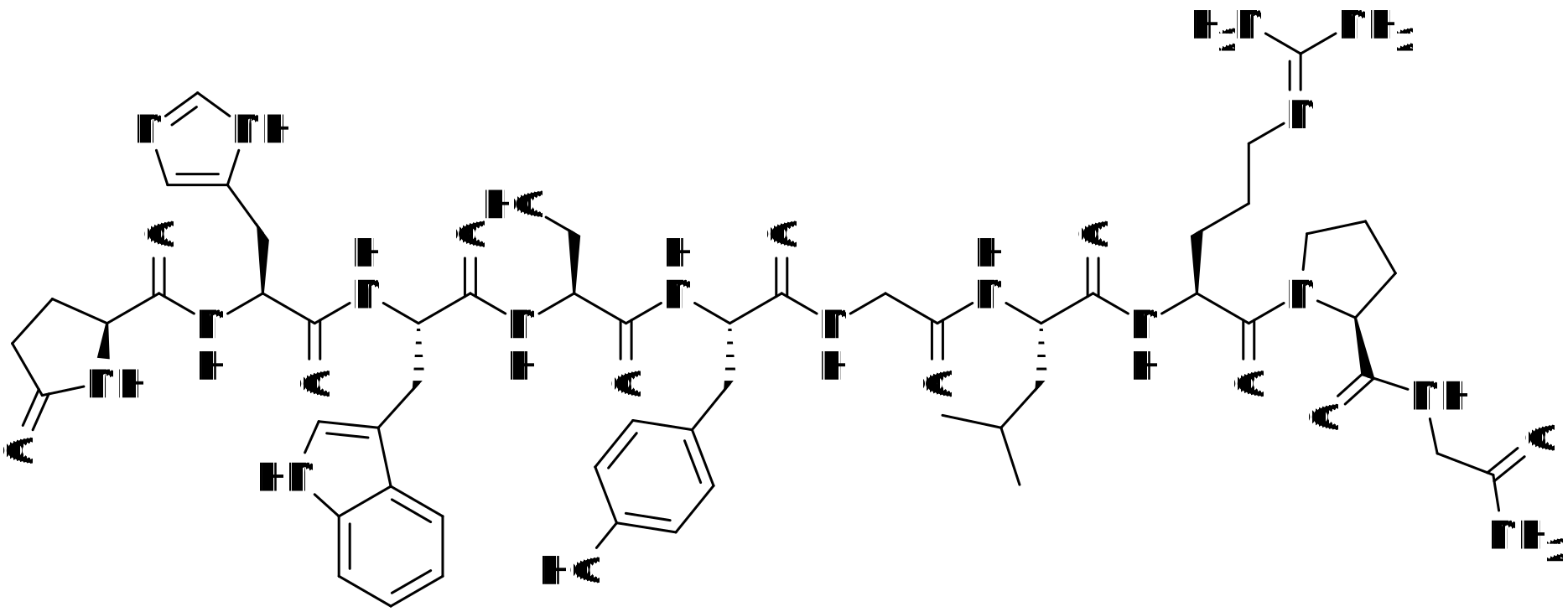
Two-dimensional skeletal structural formula of gonadorelin (GnRH / LHRH), the natural human decapeptide pyroglutamyl-histidyl-tryptophyl-seryl-tyrosyl-glycyl-leucyl-arginyl-prolyl-glycinamide, showing the N-terminal pyroglutamate and C-terminal glycine amide modifications.
Image credit: Edgar181, via Wikimedia Commons · Public Domain
Amino Acid Sequence
pyroE-H-W-S-Y-G-L-R-P-G-NH₂ (also written <pGlu>-His-Trp-Ser-Tyr-Gly-Leu-Arg-Pro-Gly-NH₂; linear decapeptide with N-terminal pyroglutamate and C-terminal glycinamide; identical sequence to endogenous human GnRH/LHRH)
Molecular Formula
C₅₅H₇₅N₁₇O₁₃ (free base)
Molecular Weight
1182.31 g·mol⁻¹ (free base); ~1302.4 g·mol⁻¹ (diacetate salt, Lutrepulse / Lutrelef); free-base value used in chemistry databases — verify the salt-form value against the specific certificate of analysis or SmPC at point of use
CAS Number
33515-09-2 (free base); 71447-49-9 (diacetate salt — Lutrepulse / Lutrelef); 51952-41-1 (hydrochloride salt — Factrel)
PubChem CID
638793
DrugBank ID
DB00644
IUPAC Name
5-oxo-L-prolyl-L-histidyl-L-tryptophyl-L-seryl-L-tyrosyl-glycyl-L-leucyl-L-arginyl-L-prolyl-glycinamide
Solubility
Water-soluble; lyophilised peptide is reconstituted with sterile water for injection or normal saline for subcutaneous or intravenous administration. Insoluble in organic solvents.
Storage
Lyophilised powder stored at 2–8 °C protected from light. Reconstituted solutions show short-term stability at 2–8 °C consistent with pulsatile-pump cassette use (typically up to 24 hours on-pump). Verify against product-specific SmPC.

Mechanism of Action

Gonadorelin is identical in sequence to endogenous human GnRH and acts as a full agonist at the gonadotropin-releasing hormone receptor (GnRHR / GnRH-R1) on anterior-pituitary gonadotrophs. The pharmacological response is frequency-dependent: physiologic pulsatile exposure stimulates gonadotropin secretion, whereas continuous exposure causes receptor desensitisation and downregulation — the mechanistic basis on which the synthetic GnRH agonists achieve therapeutic gonadal suppression in prostate cancer and endometriosis.

GnRH is the master regulator of the hypothalamic-pituitary-gonadal axis. Endogenously, hypothalamic GnRH neurons release the decapeptide into the hypophyseal-portal circulation in discrete pulses at a frequency tuned by reproductive physiology — roughly one pulse every 60–120 minutes in the follicular phase, with frequency modulating the LH:FSH ratio. Exogenous gonadorelin reproduces this physiology when delivered via a pulsatile pump (typically 5–20 µg subcutaneously or intravenously every 90 minutes) and so restores ovulatory cycles in women with hypothalamic amenorrhea and induces spermatogenesis in men with hypogonadotropic hypogonadism. Plasma half-life is short — distribution 2–10 minutes, terminal 10–40 minutes — which is precisely why pulsatile administration approximates physiology. By contrast, continuous exposure (sustained-release depot agonists, or simply uninterrupted infusion of native gonadorelin) initially produces a flare of LH/FSH and then desensitises and downregulates the GnRH receptor within ~1–2 weeks, collapsing gonadotropin output. This continuous-exposure pharmacology is the mechanistic foundation for the long-acting synthetic agonists (leuprolide, goserelin, triptorelin, buserelin, nafarelin) used in prostate cancer, endometriosis and central precocious puberty — and is therapeutically opposite to the pulsatile-pump use of gonadorelin itself.
Molecular Targets

  • GnRH receptor (GnRHR / GnRH-R1) — primary target; Class A seven-transmembrane GPCR on pituitary gonadotrophs, full agonist
  • Gαq/11 — primary G-protein coupling; mediates PLCβ activation and IP₃/DAG generation
  • Indirect axis: pituitary LH/FSH secretion → ovarian (theca/granulosa) and testicular (Leydig/Sertoli) steroidogenesis and gametogenesis

Signaling Pathways

  • GnRHR → Gαq/11 → PLCβ → cleavage of PIP₂ into IP₃ + DAG → IP₃-mediated Ca²⁺ mobilisation from the ER and DAG/Ca²⁺-mediated PKC activation
  • PKC and Ca²⁺/calmodulin → ERK, JNK and p38 MAPK cascades → transcription of LH-β and FSH-β subunit genes and exocytosis of LH/FSH from gonadotroph secretory granules
  • Frequency encoding: faster pulse frequencies (~60 min) favour LH secretion; slower pulse frequencies (~120–180 min) favour FSH secretion — continuous exposure produces an initial flare followed by receptor desensitisation and downregulation

Research Applications

The evidence base for gonadorelin rests on the Schally / Matsuo structural elucidation of 1971, the Crowley / Santoro pulsatile-pump programmes of the 1980s for hypothalamic amenorrhea (the Lutrepulse approval), the Liu 1988 long-term comparison of pulsatile GnRH versus hCG/hMG for spermatogenesis induction in male hypogonadotropic hypogonadism, the diagnostic LHRH-stimulation paradigm and the veterinary Ovsynch literature (Pursley 1995). The pivotal human pulsatile-pump trials predate ClinicalTrials.gov registration.

Diagnostic GnRH/LHRH stimulation test — endocrinology standard since the 1970s

observational

Studies report that a 100-µg intravenous (or subcutaneous) bolus of gonadorelin reliably evokes a 4- to 5-fold rise in serum LH peaking at 15–30 minutes, with a smaller FSH response, in subjects with intact pituitary function — the basis for differentiating hypothalamic from pituitary causes of hypogonadotropic hypogonadism.

— Factrel labelling (RxList); StatPearls — Physiology, GnRH

Primary hypothalamic amenorrhea — Lutrepulse pulsatile pump (multicentre Phase III equivalent, n=109)

Phase III

Studies report ovulation in 91% of primary and 96% of secondary hypothalamic-amenorrhea cycles under intravenous pulsatile gonadorelin every 90 minutes; multiple-pregnancy incidence was 12%, and IV-line complications ranged 0–11% across centres (mean 7%).

— Santoro et al., Am J Obstet Gynecol 1990;163(5 Pt 2):1759–1764

Male hypogonadotropic hypogonadism — pulsatile GnRH vs hCG/hMG (24-month head-to-head)

observational

Studies report that 24 months of pulsatile subcutaneous GnRH and combined hCG/hMG produced comparable testicular volume increases and sperm output in men with isolated hypogonadotropic hypogonadism from the inception of therapy; pulsatile GnRH did not accelerate testicular growth or shorten time to spermatogenesis versus gonadotropins in this indication.

— Liu et al., J Clin Endocrinol Metab 1988;67(6):1140–1145

Congenital hypogonadotropic hypogonadism / Kallmann syndrome — pulsatile GnRH long-term cohort (n=76, up to 24 months)

observational

Studies report, in an Endotext cohort of 76 men receiving pulsatile GnRH (typically 25–600 ng/kg every 2 hours), restoration of normal serum testosterone in 93% of patients; spermatogenesis was achieved in 77% by month 12 and 82% by month 24.

— Hayes, Dwyer & Pitteloud, Endotext — Hypogonadotropic Hypogonadism

Veterinary ovulation synchronisation — Ovsynch protocol in lactating dairy cows

in vivo

Studies report that the Ovsynch protocol (gonadorelin on day 0, PGF₂α on day 7, second gonadorelin 48 h later, fixed-time AI 16–24 h after the second GnRH) achieved synchronised ovulation in 87–100% of lactating dairy cows — the foundation of modern bovine reproductive-management programmes.

— Pursley, Mee & Wiltbank, Theriogenology 1995;44(7):915–923

Clinical Status

Regulatory Status
Originally approved by the U.S. FDA in 1978 as Factrel® (Wyeth-Ayerst, gonadorelin hydrochloride) for the diagnostic LHRH stimulation test — the human US brand has since been discontinued (not for safety or efficacy reasons). Lutrepulse® (Ferring, gonadorelin acetate) was FDA-approved for pulsatile-pump treatment of primary hypothalamic amenorrhea (5–20 µg every 90 minutes IV/SC) and subsequently withdrawn from the US market for commercial reasons. Lutrelef® (Ferring) remains available in several EU markets and was re-introduced in Canada in 2012 with the OmniPod subcutaneous pulsatile-delivery device for ovulation induction in primary hypothalamic amenorrhea. Veterinary Factrel® (Zoetis, NADA 139-237) remains active in the United States for the treatment of ovarian follicular cysts in dairy cows and for ovulation synchronisation with PGF₂α; Cystorelin (Boehringer Ingelheim) and Fertagyl (Intervet/Merck Animal Health) are widely used internationally. Compounding-pharmacy supply for off-label use in the US is not equivalent to FDA approval.
Show more
Highest Trial Phase
Phase III approved / standard of care (human diagnostics and pulsatile-pump treatment of hypothalamic amenorrhea, FDA and EU); long-standing post-marketing and veterinary experience
Sponsor
Originator Ayerst Laboratories → Wyeth-Ayerst → Wyeth → Pfizer (human Factrel; discontinued in the US). Lutrepulse / Lutrelef: Ferring Pharmaceuticals. Veterinary Factrel: Zoetis. Cystorelin: Boehringer Ingelheim. Fertagyl: Intervet/Merck Animal Health.
Show more

Safety Profile

Observed in research settings

In published pulsatile-pump and diagnostic-bolus studies, gonadorelin has been generally well tolerated; the most common adverse events observed in research settings are mild and self-limited (local injection-site reactions, transient flushing, headache, nausea), with rare reports of hypersensitivity / anaphylactoid reactions during repeated dosing. The principal pulsatile-pump-specific safety concern is multiple pregnancy (~12% in the pivotal Lutrepulse dataset).

Adverse Events Reported in Studies

  • Injection-site reactions — pain, swelling, induration, pruritus
  • Transient facial flushing
  • Headache, light-headedness, dizziness
  • Nausea and abdominal discomfort
  • Skin rash
  • Indwelling IV-line complications (thrombophlebitis, infection) reported in 0–11% of patients across Lutrepulse centres (mean 7%)

Serious Adverse Events

  • Hypersensitivity / anaphylactoid reactions — rare but reported during repeated chronic administration (one published case report of IgE-mediated hypersensitivity during chronic Factrel therapy)
  • Multiple pregnancy (~12% incidence) as a direct biological consequence of pulsatile-pump ovulation induction in the pivotal Lutrepulse cohort
  • Ovarian hyperstimulation syndrome (OHSS) — uncommon at physiologic-replacement pulsatile dosing; risk markedly increased with concomitant clomiphene or gonadotropin co-administration
  • Pituitary apoplexy — a single post-marketing case of sudden blindness following GnRH administration in a patient with an undiagnosed pituitary adenoma
  • Initial flare with continuous (non-pulsatile) administration — transient rise in LH/FSH and sex steroids before desensitisation; clinically relevant only with non-pulsatile regimens

References

  1. Schally AV, Arimura A, Baba Y, Nair RM, Matsuo H, Redding TW, Debeljuk L, White WF Isolation and properties of the FSH and LH-releasing hormone Biochem Biophys Res Commun 1971;43(2):393–399. 1971 .

  2. Matsuo H, Baba Y, Nair RM, Arimura A, Schally AV Structure of the porcine LH- and FSH-releasing hormone. I. The proposed amino acid sequence Biochem Biophys Res Commun 1971;43(6):1334–1339. 1971 .

  3. Santoro N, Wierman ME, Filicori M, Waldstreicher J, Crowley WF Jr Intravenous administration of pulsatile gonadotropin-releasing hormone in hypothalamic amenorrhea: effects of dosage J Clin Endocrinol Metab 1986;62(1):109–116. 1986 .

  4. Santoro N Efficacy and safety of intravenous pulsatile gonadotropin-releasing hormone: Lutrepulse for injection Am J Obstet Gynecol 1990;163(5 Pt 2):1759–1764. 1990 .

  5. Liu L, Banks SM, Barnes KM, Sherins RJ Two-year comparison of testicular responses to pulsatile gonadotropin-releasing hormone and exogenous gonadotropins from the inception of therapy in men with isolated hypogonadotropic hypogonadism J Clin Endocrinol Metab 1988;67(6):1140–1145. 1988 .

  6. Pursley JR, Mee MO, Wiltbank MC Synchronization of ovulation in dairy cows using PGF₂α and GnRH Theriogenology 1995;44(7):915–923. 1995 .

  7. Hayes FJ, Dwyer AA, Pitteloud N Hypogonadotropic Hypogonadism (HH) and Gonadotropin Therapy Endotext [Internet], MDText.com — South Dartmouth, MA. 2017 .

  8. Marques P, Skorupskaite K, Rozario KS, Anderson RA, George JT Physiology of GnRH and Gonadotropin Secretion Endotext / StatPearls — NCBI Bookshelf. 2022 .

  9. DrugBank Gonadorelin — DB00644 DrugBank Online. 2024 .

  10. U.S. National Library of Medicine — DailyMed FACTREL (gonadorelin hydrochloride) injection — current Zoetis veterinary label, NADA 139-237 DailyMed. 2023 .

  11. Ferring Pharmaceuticals (Canada) Lutrepulse (gonadorelin acetate for injection) — Product Monograph, Control No. 187199 Ferring Canada. 2016 .

Frequently Asked Questions

What is gonadorelin?
Gonadorelin is the natural human gonadotropin-releasing hormone (GnRH, also called LHRH) — a 10-amino-acid peptide (pyroE-H-W-S-Y-G-L-R-P-G-NH₂) produced by the hypothalamus that stimulates the anterior pituitary to release LH and FSH. Pharmaceutical gonadorelin is sequence-identical to the endogenous hormone, supplied as the acetate or hydrochloride salt for diagnostic and pulsatile-pump use.
How does gonadorelin differ from leuprolide, goserelin, triptorelin, buserelin or nafarelin?
Those are synthetic long-acting GnRH agonists designed with amino-acid substitutions (typically D-amino acids at position 6) that resist enzymatic cleavage and extend the half-life from minutes to weeks. When delivered as depot or daily injections they produce continuous GnRH-receptor exposure that, after an initial 1–2-week flare, desensitises and downregulates the receptor and suppresses gonadal sex-steroid production — the basis for their use in prostate cancer, endometriosis, uterine fibroids and central precocious puberty. Gonadorelin retains the natural sequence and short half-life, so it must be delivered pulsatilely (every 90 minutes via pump) to stimulate rather than suppress the axis.
How does gonadorelin compare with the GnRH antagonists (cetrorelix, ganirelix, degarelix)?
The antagonists block GnRH-receptor signalling immediately, without the agonist flare, and are used in IVF cycles (cetrorelix, ganirelix) and in prostate cancer (degarelix). They are mechanistically opposite to gonadorelin: blockers, not agonists.
Is gonadorelin still available?
It depends on jurisdiction. In the US, the human Factrel (Wyeth-Ayerst) and Lutrepulse (Ferring) brands are both discontinued, although the veterinary Factrel (Zoetis, NADA 139-237) for cattle remains active. In Canada and several EU countries, Lutrelef (Ferring) is still available for pulsatile-pump treatment of primary hypothalamic amenorrhea. Synthesised gonadorelin acetate is also supplied through compounding pharmacies in some markets, but compounding-pharmacy availability is not equivalent to a regulatory authorisation.
What is the GnRH/LHRH stimulation test?
A diagnostic procedure in which a single 100-µg gonadorelin bolus is given intravenously (or subcutaneously) and serum LH and FSH are measured at baseline and 15–60 minutes. A normal response (typically a 4- to 5-fold rise in LH peaking at ~15–30 minutes) is consistent with intact pituitary gonadotrope function; a flat response is consistent with pituitary failure. The test is used in the evaluation of hypogonadotropic hypogonadism, delayed or precocious puberty and secondary amenorrhea.
Why does pulsatile dosing matter?
Because the GnRH receptor is frequency-tuned. Endogenous GnRH is released in pulses every 60–120 minutes, and that pulsatility is what allows the gonadotrophs to secrete LH/FSH episodically. Continuous GnRH-receptor exposure (whether from a long-acting agonist analogue or from a non-physiologic infusion of native gonadorelin) produces an initial flare followed by receptor desensitisation and downregulation within ~1–2 weeks, collapsing gonadotropin output. This is therapeutically useful when suppression is the goal (prostate cancer, endometriosis) but therapeutically counter-productive when stimulation is the goal (ovulation induction, spermatogenesis induction). For gonadorelin specifically, the indicated route is pulsatile pump dosing every 90 minutes.