Glycoprotein hormone mixture (FSH + LH activity; reproductive-endocrine research) Limited Human Data

HMG

Also Known As: Menotropin, Human Menopausal Gonadotropin, hMG

IMPORTANT EDITORIAL CLARIFICATION: HMG (human menopausal gonadotropin / menotropin) is NOT a synthetic peptide and NOT a single defined sequence. It is a glycoprotein hormone mixture, historically purified from the urine of post-menopausal women, providing both follicle-stimulating-hormone (FSH) activity and luteinizing-hormone (LH) activity. FSH and LH are both heterodimeric glycoproteins (α + β subunits, ~200 residues total) with extensive post-translational glycosylation. HMG has been an established fertility therapy since the 1960s for controlled ovarian hyperstimulation (COH) in in-vitro fertilisation (IVF) and intracytoplasmic sperm injection (ICSI), and for ovulation induction in anovulatory women. Triscience lists HMG strictly as a research entry — users must be aware that it is a biologic glycoprotein product, not a defined chemical substance like the other peptides in the portfolio. Research use only.

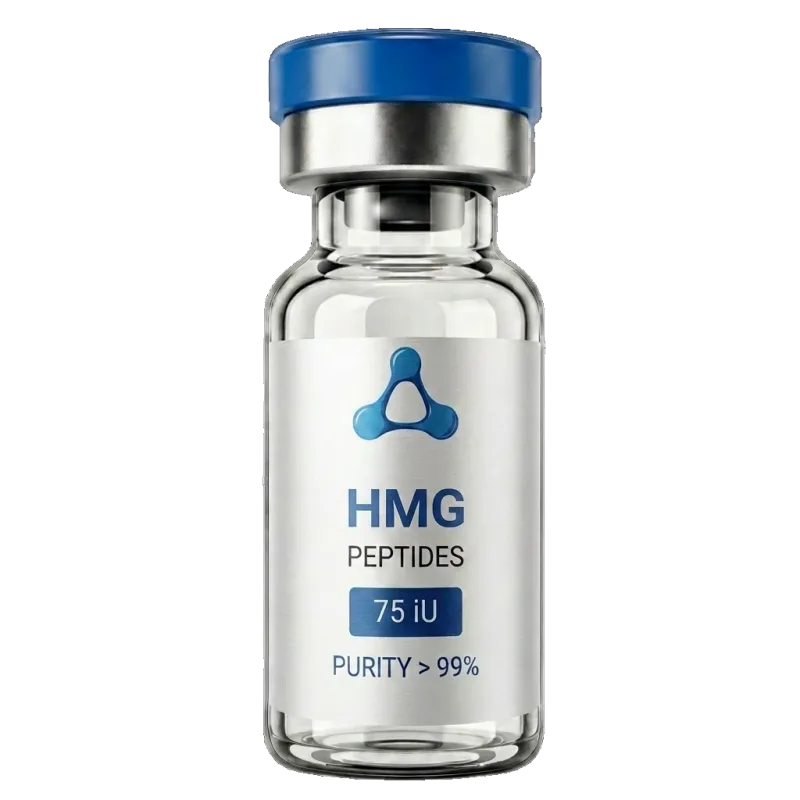
HMG – peptide vial product image

Identity & Chemistry

Amino Acid Sequence
NOT A SINGLE PEPTIDE. HMG (menotropin) is a glycoprotein hormone mixture containing follicle-stimulating hormone (FSH) and luteinizing hormone (LH) activity, traditionally purified from the urine of post-menopausal women. FSH and LH are heterodimeric glycoproteins (α + β subunits, ~200 residues total) — not synthetic peptides and not single defined sequences.
Molecular Formula
Mixture — no single molecular formula (FSH ≈ C975H1513N267O304S26; LH ≈ C681H1056N174O218S15 for the apoproteins, plus heterogeneous glycosylation)
Molecular Weight
Approximate apoprotein masses: FSH ≈ 30 kDa, LH ≈ 28 kDa (glycoforms vary by source)
CAS Number
9002-68-0 (menotropin, mixture)
IUPAC Name
Not applicable — glycoprotein hormone mixture, not a single chemical entity

Mechanism of Action

HMG delivers both FSH and LH bioactivity. FSH stimulates ovarian granulosa cells (follicular maturation); LH stimulates theca cells (androgen production) and triggers the ovulatory surge.

In reproductive medicine HMG is used for controlled ovarian hyperstimulation in IVF / ICSI protocols. The relative FSH/LH content per ampoule (typically 75 IU FSH + 75 IU LH activity) makes it a dual-active alternative to recombinant FSH alone.

Molecular Targets

  • FSH receptor (granulosa cells — follicular maturation)
  • LH/CG receptor (theca cells, corpus luteum cells — androgen production, ovulation, luteal phase)

Signaling Pathways

  • Gs → cAMP → PKA → steroidogenesis and follicular maturation

Research Applications

HMG has been established in reproductive medicine since the 1960s. Most modern data compare HMG with recombinant FSH in IVF / ICSI protocols and find broadly equivalent clinical outcomes.

IVF / ICSI — controlled ovarian hyperstimulation (meta-analysis)

Phase IV

The Coomarasamy 2008 meta-analysis reports that urinary HMG produces modestly higher clinical pregnancy rates than recombinant FSH in agonist long-down-regulation protocols (clinical pregnancy odds ratio 1.18, 95 % CI 1.02–1.38).

— Coomarasamy et al. 2008, Hum Reprod 23(2):310-315 (PMID 18056719)

Clinical Status

Regulatory Status
HMG / menotropin is an approved and established fertility therapy — for example Menopur® (Ferring) is approved in the US, EU and many other markets. IMPORTANT: Triscience does NOT list HMG as a pharmaceutical product but strictly as a research entry. The listing here does not imply therapeutic use.
Show more
Sponsor
Historically: Serono (Pergonal, withdrawn). Currently: Ferring Pharmaceuticals (Menopur®) and several generic manufacturers.

Safety Profile

Observed in research settings

Limited human data in the Triscience research context. In the clinical reproductive-medicine setting, the principal safety concerns are ovarian hyperstimulation syndrome (OHSS) and multiple pregnancies.

Adverse Events Reported in Studies

  • Injection-site reactions
  • Abdominal pain / bloating (in the COH context)
  • Ovarian hyperstimulation syndrome (OHSS) — clinically relevant in fertility therapy

Serious Adverse Events

  • Severe OHSS (rare, in clinical COH setting)
  • Multiple pregnancies (clinically relevant in reproductive medicine)

References

  1. Lunenfeld B Historical perspectives in gonadotrophin therapy Human Reproduction Update 2004;10(6):453-467. 2004 .

  2. Coomarasamy A, Afnan M, Cheema D, van der Veen F, Bossuyt PMM, van Wely M Urinary HMG versus recombinant FSH for controlled ovarian hyperstimulation following an agonist long down-regulation protocol in IVF or ICSI treatment: a systematic review and meta-analysis Human Reproduction 2008;23(2):310-315. 2008 .

  3. Practice Committee of the American Society for Reproductive Medicine Use of exogenous gonadotropins for ovulation induction in anovulatory women: a committee opinion Fertility and Sterility 2020;113(1):66-70. 2020 .

Frequently Asked Questions

Is HMG a synthetic peptide?
No. HMG is a glycoprotein hormone mixture, historically purified from the urine of post-menopausal women. It contains FSH and LH activity. It is not a single defined sequence and is categorically different from synthetic peptides such as BPC-157 or tirzepatide.
Is HMG used clinically?
Yes — HMG (e.g. Menopur®) is an approved fertility therapy for controlled ovarian hyperstimulation in IVF / ICSI protocols and for ovulation induction. Triscience, however, lists HMG strictly as a research entry.