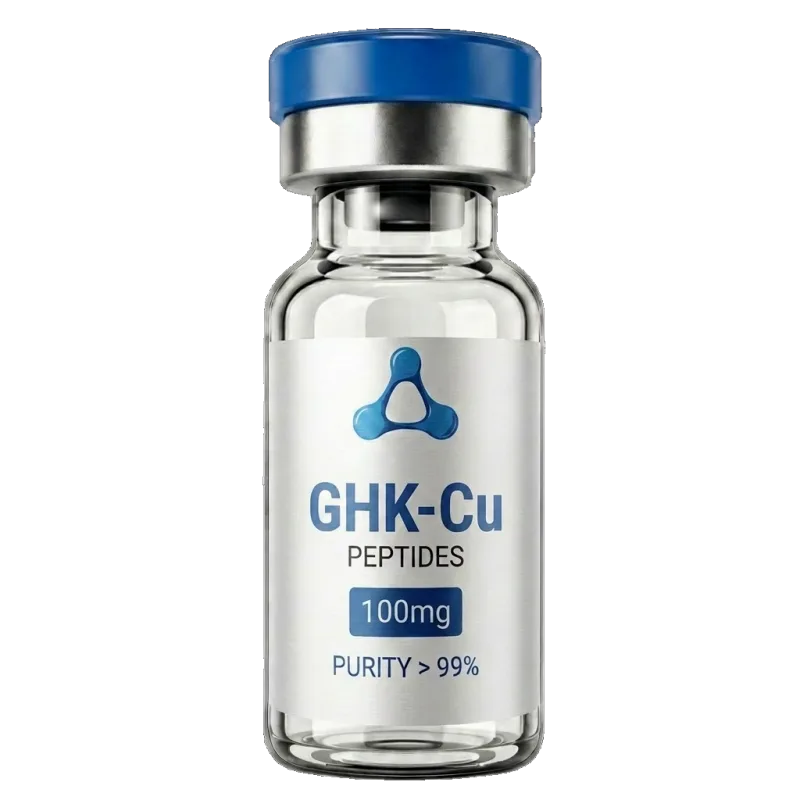
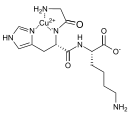
GHK-Cu is a copper-delivery vehicle and a broad transcriptional modulator: in Connectivity-Map analyses, studies report that GHK significantly modulates ≈32% of human genes (≥50% change threshold), with coordinated up-regulation of DNA-repair, antioxidant, and ubiquitin-proteasome gene sets and down-regulation of pro-inflammatory and metastatic-cancer programmes. There is no single canonical receptor; biological activity is mediated by chelated copper bioavailability and by gene-expression effects observable at nanomolar peptide concentrations.
Loren Pickart isolated GHK in 1973 from human plasma albumin as the active fraction that allowed aged hepatocytes to synthesise proteins like young hepatocytes, publishing the discovery in Nature New Biology (Pickart & Thaler 1973, PMID 4349963), with a synthetic-tripeptide confirmation report in Biochem Biophys Res Commun (PMID 4356974) the same year. Subsequent work — by the Pickart group and several independent dermatology, biochemistry, and biophysical-chemistry teams — established that GHK chelates Cu(II) with a stability constant high enough (log K ≈ 16) to outcompete albumin's high-affinity Cu site, producing a square-planar GHK·Cu²⁺ complex in which copper is redox-silenced. Endogenous plasma GHK declines from ≈200 ng/mL at age 20 to ≈80 ng/mL at age 60, which the Pickart laboratory has proposed as a partial mechanistic explanation for age-related decline in tissue regenerative capacity (Pickart et al. 2012, OMCL). Modern transcriptomic analyses using Connectivity-Map data report that GHK significantly modulates ≈32% of human genes (≥50% change threshold), including coordinated up-regulation of DNA-repair, antioxidant, and ubiquitin-proteasome gene sets and down-regulation of pro-inflammatory and metastatic-cancer gene programmes (Pickart et al. 2014, BMRI). Editorial convention: each mechanistic finding above explicitly names whether it was demonstrated with free GHK (copper supplied by serum) or with the pre-formed GHK·Cu²⁺ complex, because the primary literature does not always disambiguate.