Mitochondria-targeting synthetic tetrapeptide (Szeto–Schiller / MTP class) — mitochondrial / longevity research; FDA-approved 2025 for Barth syndrome (FORZINITY)
Elamipretide
Also Known As: SS-31, MTP-131, Bendavia, Forzinity, RX-31
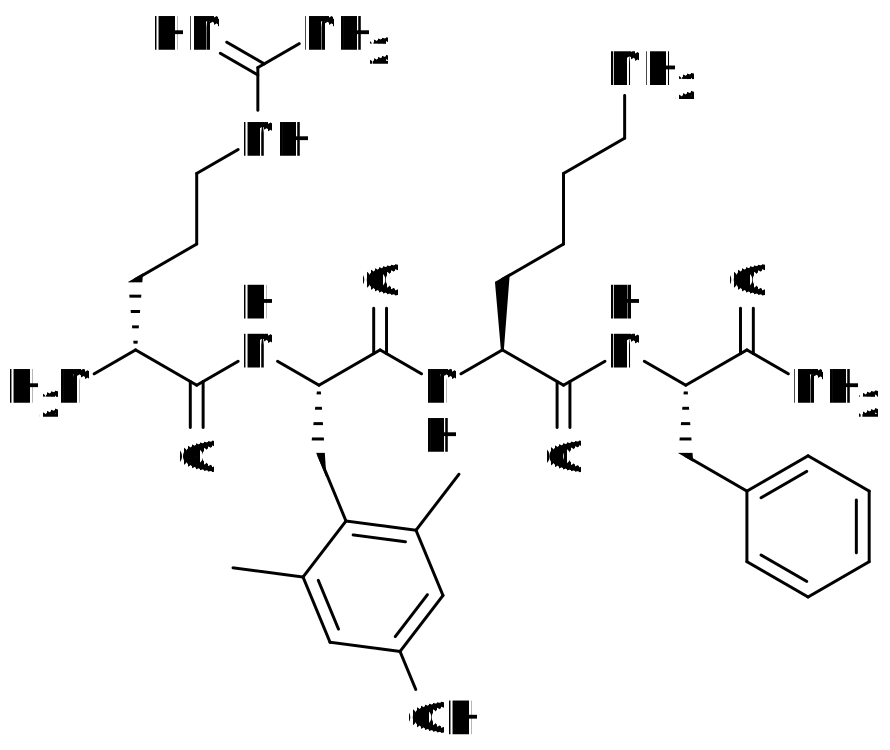
Elamipretide (INN; synonyms SS-31, MTP-131, Bendavia, brand name Forzinity) is a synthetic, cell-permeable, mitochondria-targeting tetrapeptide with the sequence H-D-Arg-Tmt-Lys-Phe-NH₂, in which Tmt denotes the non-proteinogenic residue 2′,6′-dimethyltyrosine. It is the prototype of the Szeto–Schiller (SS) / mitochondria-targeting tetrapeptide (MTP) class developed in the early 2000s by Hazel Szeto and Peter Schiller at Weill Cornell Medicine (Szeto 2014, Br J Pharmacol, PMID 24117165; Birk 2013, J Am Soc Nephrol, PMID 23813215). Studies report that the alternating aromatic-cation motif (D-Arg(+) / Tmt(aromatic) / Lys(+) / Phe(aromatic)) binds reversibly to cardiolipin on the inner mitochondrial membrane (IMM), stabilises cristae architecture, prevents cardiolipin peroxidation by the cytochrome-c–cardiolipin complex, and preserves respiratory supercomplex assembly. A central mechanistic feature is that mitochondrial accumulation is INDEPENDENT of the membrane potential (ΔΨm) — in contrast to the triphenylphosphonium (TPP⁺) conjugates of the MitoQ class, which require an intact ΔΨm. On 19 September 2025 the U.S. Food and Drug Administration granted FORZINITY (elamipretide HCl injection, NDA 215244, sponsor Stealth BioTherapeutics Inc.) accelerated approval "to improve muscle strength in adult and pediatric patients with Barth syndrome weighing at least 30 kg" — the FIRST FDA-approved therapy for Barth syndrome and the FIRST FDA-approved mitochondria-targeted peptide therapeutic. The supporting Advisory Committee (FDA Peripheral and Central Nervous System Drugs Advisory Committee, PCNS) voted 10 to 6 in favour of accelerated approval on 10 October 2024 — a widely discussed vote because the underlying TAZPOWER trial (NCT03098797, n = 12) had missed its randomised crossover primary endpoint and approval rests on the open-label extension. Honest framing: most non-Barth Phase 2/3 trials have MISSED their primary endpoints — MMPOWER-3 (NCT03323749, primary mitochondrial myopathy, n = 218, both co-primary endpoints missed; Karaa 2023, Neurology, PMID 37268435), EMBRACE-STEMI (NCT01572909, STEMI reperfusion, n = 300, primary infarct-size endpoint missed), PROGRESS-HF (NCT02814097, HFrEF, n = 71, LVESV endpoint missed), and ReCLAIM-2 (NCT03891875, dry AMD, n = 176, minimal between-group differences). Only the Barth-syndrome / TAZPOWER pillar carries the approval; all other indications remain investigational and are described for research purposes only. The Phase 3 confirmatory programme in geographic atrophy (ReNEW / SPIAM-301, NCT06373731) is active-not-recruiting at the 2026-05-01 audit; primary completion estimated August 2027. Important disambiguation versus the in-category sibling: MOTS-c (see [/portfolio/mots-c](/portfolio/mots-c)) is a mitochondria-DERIVED peptide (encoded within the MT-RNR1 / 12S rRNA gene on mitochondrial DNA), whereas elamipretide is a mitochondria-TARGETING synthetic peptide that is NOT encoded by any human gene — the two share the category but are chemically and mechanistically distinct. Pre-approval, elamipretide fell under WADA category S0 (non-approved substances) for sport; the classification on the 2026 WADA Prohibited List should be re-checked at point of use after the September 2025 approval.