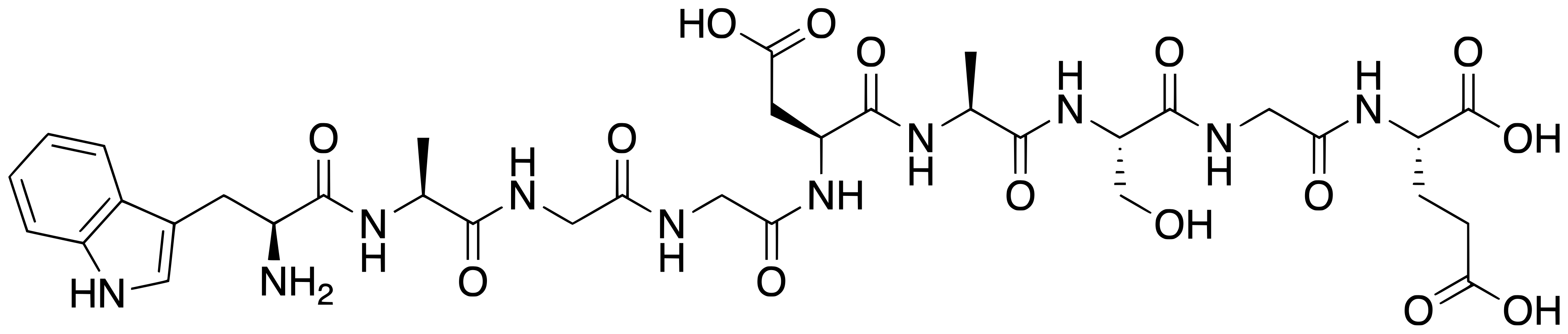
Studies report pleiotropic effects of DSIP, BUT no DSIP receptor has been identified after 40+ years of research. Reported actions include (i) modulation of sleep architecture / EEG slow-wave activity (original Schoenenberger finding 1977 in rabbits), (ii) dampening of stress-induced cortisol responses, (iii) non-opioid antinociception (naloxone-INSENSITIVE, Yehuda & Carasso 1987), (iv) protection against oxidative stress in preclinical hypoxia models, and (v) indirect modulation of GABAergic and NMDA currents. Important: DSIP does NOT bind directly to GABA-A or the benzodiazepine binding site — it is NOT a classical sedative. Observed in research settings; mechanism pending receptor-level validation.
The mechanistic narrative around DSIP is shaped by the unresolved receptor problem. Schoenenberger & Monnier isolated DSIP in 1977 by dialysis of cerebral venous blood from rabbits subjected to electrical stimulation of the intralaminar thalamic area, and named the peptide for its reported EEG delta-wave-enhancing property. In the five decades since, no DSIP receptor has been cloned; there is no pharmacologically validated molecular binding site. Kovalzon & Strekalova (2006, J Neurochem PMID 16539679) explicitly characterise DSIP as "a still unresolved riddle" and question whether DSIP is a true endogenous sleep factor at all. The reported actions are pleiotropic: Yehuda & Carasso (1987 Int J Neurosci PMID 3679693) reported naloxone-insensitive antinociception in rats — i.e. NOT a classical opioid mechanism. Khvatova et al. (2003 Peptides PMID 12668217) reported mitochondrial protection against hypoxia-induced respiratory loss at 120 µg/kg DSIP. Tukhovskaya et al. (2021 Molecules PMID 34500605) reported improved motor function (rotarod) and reduced infarct size in a focal stroke model in SD rats; this replication, however, comes from the Mikhaleva / Russian-group lineage rather than Western independent replication. In human data, a small (n=24) RANDOMISED PILOT exists during isoflurane anaesthesia — Pomfrett et al. (2009 Eur J Anaesthesiol PMID 19142086) reported dose-dependent changes in bispectral index (BIS), EEG, and heart rate variability at DSIP 25 / 50 / 100 nmol/kg versus saline. This is NOT a sleep RCT; it is an anaesthesia-adjunct pilot. IMPORTANT EDITORIAL SCOPING: DSIP is NOT a classical sedative-hypnotic, does NOT bind to GABA-A or the benzodiazepine binding site, and CANNOT be framed as a "benzodiazepine alternative" — vendor and forum narratives of that type are scientifically UNSUPPORTED. Mechanism statements here are intentionally hedged — studies report, observed in research settings — and never framed as established human pharmacology. Research use only.