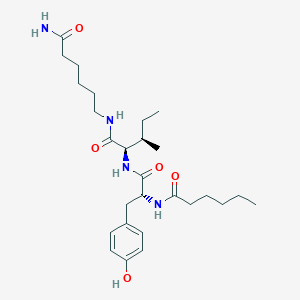
Studies from the Harding group at Washington State University report that Dihexa functions as a positive modulator of the hepatocyte growth factor (HGF) / c-Met receptor system, augmenting HGF-driven MAPK and PI3K-AKT signalling and downstream dendritic spinogenesis, hippocampal LTP and synaptogenesis. Dihexa is NOT an angiotensin II receptor (AT1 / AT2) agonist despite its angiotensin-IV lineage. Observed in research settings.
The mechanistic narrative built by the WSU group is that angiotensin IV–derived peptides act not via classical angiotensin receptors but via the brain HGF/c-Met neurotrophic system. Dihexa, the metabolically stabilised and brain-penetrant analogue of angiotensin IV, is reported in McCoy 2013 and Benoist 2014 to potentiate HGF binding to c-Met, drive dimerization disruption that paradoxically AUGMENTS HGF activity at low concentrations, and increase dendritic spine density in hippocampal cultures. In behavioural assays, Dihexa is reported to reverse scopolamine-induced Morris water maze deficits in rats, improve performance in aged rats with mixed cognitive baselines, and (Sun 2021) rescue cognitive performance and reduce neuroinflammation in APP/PS1 transgenic Alzheimer's-model mice. The widely repeated claim that "Dihexa is seven orders of magnitude (≈10 million-fold) more potent than BDNF" originates SPECIFICALLY in Benoist et al. 2014 — a paper formally RETRACTED by the Journal of Pharmacology and Experimental Therapeutics on 29 April 2025. Triscience treats this potency claim as unverified as of audit date 2026-05-02 and recommends omission from marketing-style copy. The broader HGF/c-Met-as-cognitive-target hypothesis remains an active area of research and was independently advanced into clinical trials by Athira Pharma using the separate molecule fosgonimeton (ATH-1017 / NDX-1017) — fosgonimeton, however, failed its Phase 2/3 LIFT-AD Alzheimer's trial in 2023, further weakening pathway-validation evidence. Mechanism statements here are intentionally hedged — studies report, observed in research settings — and never framed as established human pharmacology. Research use only.