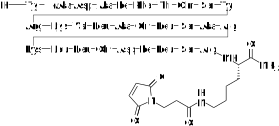
CJC-1295 has been studied in two published Phase 1 trials in healthy adults, in several preclinical papers, and in one terminated Phase 2 trial (NCT00267527). The evidence base is small and largely from the ConjuChem programme of 2005–2009. All findings are reported as investigational and for research use only.
Identification and pharmacokinetics (preclinical, rat; Jetté 2005)
preclinical Studies report that the CJC-1295–albumin conjugate produced a 4-fold increase in GH AUC over 2 hours versus unmodified hGRF(1-29) in cultured rat pituitary cells; CJC-1295 immunoreactivity in rat plasma was albumin-bound by 15 minutes and remained detectable beyond 72 hours. Identified CJC-1295 as the long-lasting GRF analogue lead.
— Jetté et al., Endocrinology 2005;146(7):3052–3058 (PMID 15817669)
Phase 1 ascending-dose study in healthy adults (Teichman 2006)
Phase I Studies report dose-dependent increases of mean plasma GH of 2- to 10-fold for ≥6 days and IGF-1 of 1.5- to 3-fold for 9–11 days after single subcutaneous CJC-1295 with DAC at 30, 60, 90, 125, or 250 µg/kg; with multiple doses, IGF-1 remained above baseline for up to 28 days. Estimated terminal half-life 5.8–8.1 days; tolerability best at 30 and 60 µg/kg.
— Teichman et al., J Clin Endocrinol Metab 2006;91(3):799–805 (PMID 16352683)
Preserved GH pulsatility under continuous stimulation (Ionescu & Frohman 2006)
Phase I Studies report unchanged GH pulse frequency and amplitude one week after a single 60- or 90-µg/kg subcutaneous CJC-1295 with DAC injection; trough GH rose ~7.5-fold, mean 12-h GH rose 46%, and IGF-1 rose 45%. Demonstrated that long-acting GHRH-receptor stimulation does not abolish physiological GH pulsatility.
— Ionescu & Frohman, J Clin Endocrinol Metab 2006;91(12):4792–4797 (PMID 17018654)
Restoration of normal growth in GHRH-knockout mice (Alba 2006)
preclinical Studies report that GHRH-knockout mice receiving once-daily subcutaneous CJC-1295 with DAC at 2 µg for 5 weeks reached body length and weight indistinguishable from wild-type littermates; 48-h dosing partially normalised growth; 72-h dosing was insufficient. Established once-daily as the minimum-frequency regimen for full growth normalisation in this model.
— Alba et al., Am J Physiol Endocrinol Metab 2006;291(6):E1290–E1294 (PMID 16822960)
HIV-associated visceral adiposity (Phase 2, terminated; NCT00267527)
Phase II Planned n=192, once-weekly CJC-1295 with DAC for up to 12 weeks vs placebo. Trial terminated by the sponsor on 17 July 2006 following the death of a participant at an Argentinian study site; the on-site investigator attributed the death to asymptomatic coronary artery disease with plaque rupture and occlusion rather than to study drug. No efficacy results were published; ConjuChem subsequently suspended the CJC-1295 programme in 2007–2008.
— ClinicalTrials.gov NCT00267527 (verified vs v2 API on 2026-05-01); aidsmap, 18 July 2006
Serum-protein biomarker analysis (Sackmann-Sala 2009)
Phase I Studies report reproducible CJC-1295-induced changes in five serum proteins (apolipoprotein A1 isoform ↓, transthyretin isoform ↓, β-haemoglobin ↑, C-terminal albumin fragments ↑, immunoglobulin fragments ↑) with a linear correlation between albumin/Ig-fragment spot intensity and IGF-1.
— Sackmann-Sala et al., Growth Horm IGF Res 2009;19(6):471–477 (PMID 19386527)
Anti-doping detectability (Henninge 2010)
observational Studies report unambiguous LC-MS/MS identification of CJC-1295 in a seized injectable preparation; demonstrated detectability of GHRH analogues in confiscated material and underpins the WADA listing of GHRH analogues under category S2.
— Henninge et al., Drug Test Anal 2010;2(11-12):647–650