Vasoactive intestinal peptide (secretin/glucagon superfamily) Limited Human Data

VIP

Also Known As: Vasoactive Intestinal Peptide, Vasoactive Intestinal Polypeptide

Vasoactive intestinal peptide (VIP) is a 28-residue peptide isolated from small intestine in 1970 by Said and Mutt. It belongs to the secretin/glucagon superfamily. VIP acts as a broad-action neuropeptide with documented vasodilatory, secretory, immunomodulatory and neuroprotective activities. VIP signals via the G-protein-coupled receptors VPAC1 and VPAC2. It has been investigated experimentally in pulmonary arterial hypertension (PAH), sarcoidosis and chronic inflammatory disease. Limited human data. Research use only.

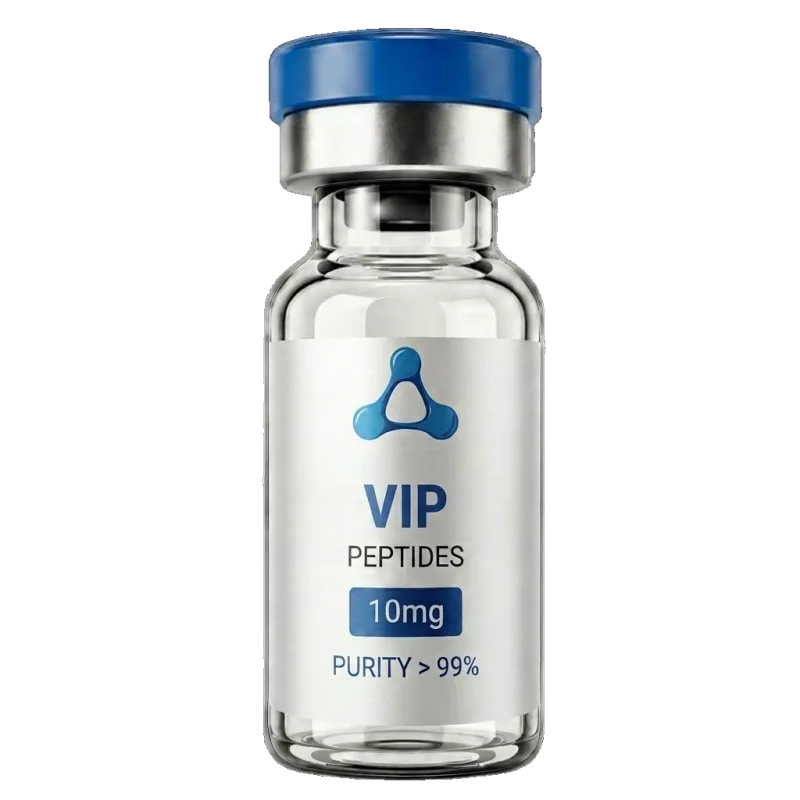
VIP – peptide vial product image

Identity & Chemistry

Amino Acid Sequence
HSDAVFTDNYTRLRKQMAVKKYLNSILN-NH₂ (28-residue C-terminally amidated peptide of the secretin / glucagon family)
Molecular Formula
C₁₄₇H₂₃₇N₄₃O₄₃S
Molecular Weight
3326.81 g·mol⁻¹
CAS Number
37221-79-7
PubChem CID
44561323
DrugBank ID
DB09120
IUPAC Name
See PubChem CID 44561323 for the canonical structural representation.

Mechanism of Action

Studies report that VIP activates the G-protein-coupled receptors VPAC1 and VPAC2, raising cAMP and producing vasodilation, immunomodulation and neuroprotection. Observed in research settings.

VIP has a central role in parasympathetic innervation of smooth muscle and in modulating innate and adaptive immune responses. In experimental models VIP has been evaluated for PAH (e.g. inhaled aviptadil), asthma and sarcoidosis; the half-life is short (minutes), which complicates clinical use.

Molecular Targets

  • VPAC1 receptor (G-protein coupled)
  • VPAC2 receptor (G-protein coupled)
  • PAC1 receptor (lower affinity; primary target of PACAP)

Signaling Pathways

  • Gs → adenylyl cyclase → cAMP → PKA
  • Smooth-muscle relaxation (vasodilation, bronchodilation)
  • TH1 → TH2 / regulatory T-cell polarization shift

Research Applications

The in-vitro and animal evidence base for VIP is large; human clinical data are smaller and heterogeneous, with the most clinical interest concentrated on aviptadil (synthetic VIP) in pulmonary hypertension and acute respiratory distress syndrome (ARDS).

Pulmonary arterial hypertension (VIP knockout mouse) — preclinical

preclinical

Studies report that VIP knockout mice develop moderate pulmonary arterial hypertension, suggesting a role for VIP in pulmonary vascular homeostasis.

— Said et al. 2007, Circulation 115(10):1260-1268 (PMID 17309917)

Immunomodulation — review

in vitro

Studies report that VIP suppresses TH1 responses, promotes TH2 / Treg responses and reduces pro-inflammatory cytokines such as TNF-α and IFN-γ.

— Delgado et al. 2004, Pharmacol Rev 56(2):249-290 (PMID 15169929, review)

Clinical Status

Regulatory Status
VIP itself is NOT an approved pharmaceutical compound. Aviptadil (synthetic VIP) has limited off-label use and was clinically evaluated for ARDS during the COVID-19 pandemic (FDA emergency-use applications filed; no full approval granted as of audit date 2026-05-12).
Show more
Highest Trial Phase
Phase 3 in COVID-19 ARDS (aviptadil); no full approval

Safety Profile

Observed in research settings

Limited human data. In reported aviptadil studies, hypotension was the most common adverse event (vasodilatory effect), followed by cutaneous flush. Observed in research settings.

Adverse Events Reported in Studies

  • Hypotension (vasodilatory effect)
  • Cutaneous flushing
  • Tachycardia (reported)

References

  1. Said SI, Mutt V Polypeptide with broad biological activity: isolation from small intestine Science 1970;169(3951):1217-1218. 1970 .

  2. Delgado M, Pozo D, Ganea D The significance of vasoactive intestinal peptide in immunomodulation Pharmacological Reviews 2004;56(2):249-290. 2004 .

  3. Said SI, Hamidi SA, Dickman KG, Szema AM, Lyubsky S, Lin RZ, Jiang YP, Chen JJ, Waschek JA, Kort S Moderate pulmonary arterial hypertension in male mice lacking the vasoactive intestinal peptide gene Circulation 2007;115(10):1260-1268. 2007 .

Frequently Asked Questions

Is VIP approved?
No. VIP itself is not an approved pharmaceutical compound. The synthetic VIP preparation aviptadil was clinically evaluated during the COVID-19 pandemic but has not received full approval.
What is the difference between VIP and PACAP?
VIP and PACAP (pituitary adenylate cyclase-activating peptide) are closely related members of the same peptide family. They activate overlapping receptors (VPAC1, VPAC2, PAC1). PACAP has higher affinity for PAC1; VIP preferentially binds VPAC1 / VPAC2.

Thymosin Alpha-1

≥98%

Thymic peptide hormone analogue / immune modulator (slug: immune-other; pleiotropic TLR2/TLR9-mediated effect rather than a classical single-receptor agonist)

Synthetic 28-amino-acid N-acetylated thymic peptide (thymalfasin / Zadaxin); pleiotropic TLR2/TLR9-mediated immune modulator — approved as Zadaxin in 35+ countries (Italy, China, Vietnam, Mexico and others) for chronic hepatitis B and as a vaccine adjuvant in immunocompromised populations, but NOT FDA-approved in the United States — only orphan-drug designations exist there.

View Details

KPV

≥98%

Investigational melanocortin tripeptide (Melanocortin research — anti-inflammatory C-terminal α-MSH(11–13) fragment, MELANOCORTIN-RECEPTOR-INDEPENDENT, NOT a tanning peptide)

KPV (Lys-Pro-Val) is the anti-inflammatory C-terminal tripeptide of α-melanocyte-stimulating hormone (residues 11–13). NOT approved by the FDA, EMA or any other regulator. Zero registered human trials (ClinicalTrials.gov v2 audit 2026-05-02). NOT a tanning peptide, NO sexual-function indication, NOT a classical melanocortin-receptor agonist — pharmacologically OPPOSITE to afamelanotide, PT-141 and Melanotan II despite a shared α-MSH lineage. Limited human data — preclinical reports only. WADA Class S0. Research use only.

View Details

BPC-157

≥98%

Synthetic cytoprotective pentadecapeptide (tissue-repair / healing research compound)

Synthetic 15-amino-acid pentadecapeptide (PL-14736) derived from a fragment of a 60-aa protein in human gastric juice. Proposed cytoprotective and angiogenic activity is largely inferred from preclinical rodent and in-vitro data; not approved by any regulator and intended for research use only.

View Details