Synthetic Cyclic Heptapeptide (Melanocortin Receptor Class — non-selective MC1R/MC3R/MC4R/MC5R agonist; investigational research compound, not approved) Limited Human Data

Melanotan II

Also Known As: MT-II, MT2, MTII, melanotan-2, MT-2

Melanotan II (MT-II) is a synthetic cyclic 7-amino-acid lactam-bridged α-MSH(4–10) analogue developed in the 1980s at the University of Arizona by Victor Hruby, Mac Hadley, Robert Dorr and Norman Levine (Al-Obeidi/Hadley/Hruby 1989, PMID 2555512). Studies report that MT-II is a non-selective full agonist at all four melanocortin receptors (MC1R / MC3R / MC4R / MC5R) in the low-nanomolar range, ~1000-fold more potent than endogenous α-MSH across all four. MT-II is NOT the same compound as bremelanotide / PT-141 (see [/portfolio/pt-141](/portfolio/pt-141) — a structurally related cyclic heptapeptide with a C-terminal carboxyl in place of the amide, CAS 189691-06-3, FDA-approved 2019 as Vyleesi for HSDD) and NOT the same compound as afamelanotide / Scenesse (see [/portfolio/afamelanotide](/portfolio/afamelanotide) — a linear 13-residue [Nle⁴, D-Phe⁷] α-MSH analogue NDP-α-MSH with no lactam cyclization, CAS 75921-69-6, EMA-approved 2014 and FDA-approved 2019 for erythropoietic protoporphyria). Vendor copy and lay press routinely conflate these three compounds; Triscience surfaces the three-way disambiguation explicitly because reader risk of confusion is unusually high. Melanotan II itself has NO FDA, EMA, or MHRA approval; the UK MHRA issued a Drug Safety Update on 17 November 2008, contacted 18 UK suppliers, and stated that advertising or supplying MT-II is illegal under the Human Medicines Regulations 2012 / Medicines Act 1968; the US FDA, Australian TGA, and Irish HPRA have issued analogous warnings. The published human evidence base is sparse — one Phase I tanning trial (Dorr 1996), one Phase I psychogenic-ED trial (Wessells 1998, PMID 9679884), and scattered case reports. A systematic ClinicalTrials.gov v2 API query on 1 May 2026 returned one (1) active interventional MT-II study: NCT07437560 (Hudson Biotech, Phase 2, vitiligo + NB-UVB, Peking University Shenzhen Hospital, recruiting). For athletes, Melanotan II is NOT explicitly named on the WADA 2026 Prohibited List; unregulated supply-chain contamination risk nevertheless applies.

Identity & Chemistry

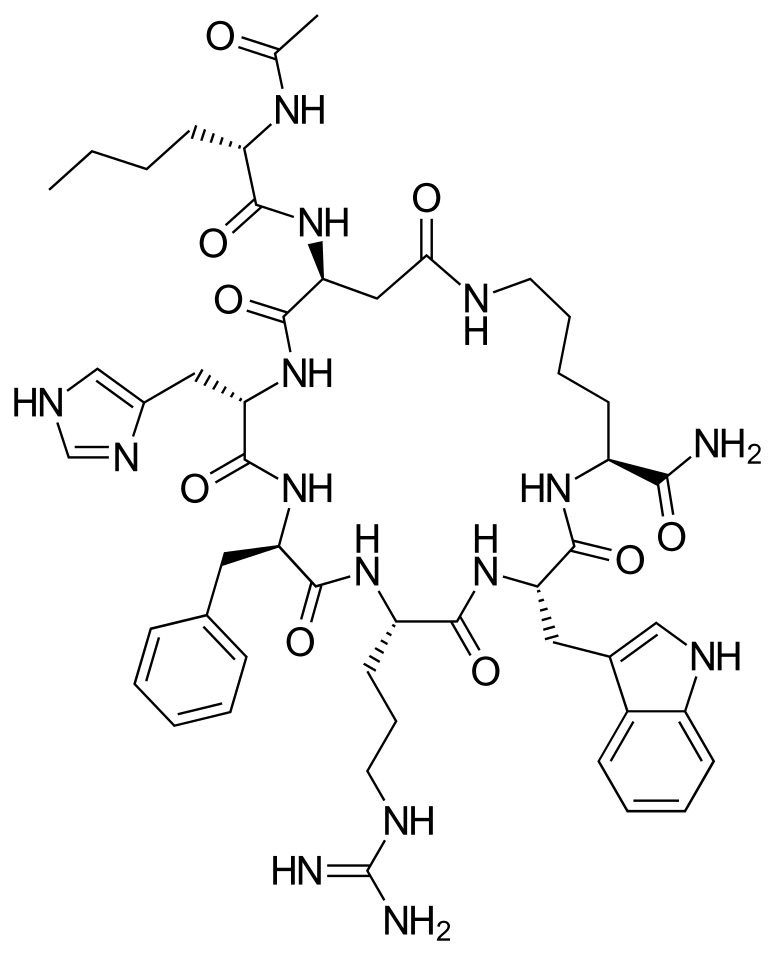
Skeletal chemical structure of Melanotan II showing the cyclic heptapeptide backbone with N-acetyl-norleucine at position 4, D-phenylalanine at position 7, and the Asp⁵–Lys¹⁰ side-chain lactam bridge that locks the pharmacophore-active β-turn conformation; C-terminal primary amide.
Image credit: Vaccinationist, via Wikimedia Commons · Public Domain
Amino Acid Sequence
Ac-Nle⁴-cyclo[Asp⁵-His⁶-D-Phe⁷-Arg⁸-Trp⁹-Lys¹⁰]-NH₂ (cyclic 7-residue lactam-bridged α-MSH(4–10) analogue; the Asp⁵–Lys¹⁰ side-chain lactam locks the peptide into a pharmacophore-active β-turn; D-Phe⁷ and N-acetyl-norleucine at position 4 confer proteolytic stability; the C-terminal primary amide is the structural disambiguator from PT-141 / bremelanotide, which carries a free –OH carboxyl)
Molecular Formula
C₅₀H₆₉N₁₅O₉
Molecular Weight
1024.18 g·mol⁻¹ (free base; PubChem CID 92432; the typical research supply form is the acetate salt)
CAS Number
121062-08-6
PubChem CID
92432
IUPAC Name
(6S,9R,12S,15S,18R,23S)-15-{[N-(acetyl)-L-norleucyl]amino}-9-benzyl-6-{3-[(diaminomethylidene)amino]propyl}-12-(1H-imidazol-5-ylmethyl)-3-(1H-indol-3-ylmethyl)-2,5,8,11,14,17-hexaoxo-1,4,7,10,13,18-hexaazacyclotricosane-23-carboxamide
Solubility
Water-soluble; the typical research supply form is the lyophilised acetate salt, reconstituted in bacteriostatic 0.9% NaCl. Quantitative aqueous-solubility data are not publicly disclosed at PubChem CID 92432.
Storage
Lyophilised peptide: store at −20 °C, desiccated, protected from light (long-term). Reconstituted solutions: store at 2–8 °C, short-term (vendor / supplier certificate of analysis governs); for research use only.

Mechanism of Action

Studies report that Melanotan II is a non-selective full agonist at all four melanocortin receptors (MC1R / MC3R / MC4R / MC5R) in the low-nanomolar EC₅₀ range; the central structural innovation versus endogenous α-MSH is the 23-membered Asp⁵–Lys¹⁰ lactam ring, combined with the D-Phe⁷ stereoinversion and the N-acetyl-Nle⁴ substitution (Al-Obeidi/Hadley/Hruby 1989, PMID 2555512). The non-selectivity is the mechanistic root of the broad off-target burden — hyperpigmentation, spontaneous erections, appetite suppression, and the yawn-stretch syndrome coexist at any pharmacologically active exposure.

Studies report that in vitro assays on cloned human melanocortin receptors yield EC₅₀ values in the low-nanomolar range for MT-II at MC1R, MC3R, MC4R, and MC5R, with full agonism at each (Hadley 1998 review). Receptor activation increases intracellular cAMP via Gαs, stimulates PKA, and at MC1R drives MITF-dependent transcription of melanogenic enzymes. At MC4R, central activation in the paraventricular nucleus has been linked to release of oxytocin and dopamine in pro-erectile and pro-sexual circuits — the mechanism inherited by PT-141 / bremelanotide. Unlike PT-141 (MC4R-preferring with lower MC1R activation — less hyperpigmentation off-target) and unlike afamelanotide (MC1R-preferring linear analogue engineered for photoprotection), MT-II hits all four receptors with comparable affinity. This non-selectivity is the mechanistic root of the broad off-target burden — hyperpigmentation, unsolicited erections, appetite suppression, and the yawn-stretch syndrome coexist at any therapeutically active exposure. Plasma half-life after subcutaneous dosing is reportedly under one hour, but the biological footprint is prolonged because the lactam constraint resists proteolysis and because MITF-driven pigment changes persist for weeks after a single dose (Hadley 1989, PMID 2555512; Dorr 1996, PMID 8637402; Wessells 2000, PMID 11018626). Mechanism statements here are intentionally hedged — studies report, observed in research settings — and never framed as established human pharmacology.
Molecular Targets

  • MC1R (skin melanocytes) — Gαs / cAMP / PKA → CREB phosphorylation → MITF transcription → tyrosinase, TYRP1, DCT upregulation → eumelanin biosynthesis; the basis of the tanning effect (Dorr 1996, PMID 8637402)
  • MC3R (hypothalamus, limbic system) — Gαs / cAMP; modulates energy homeostasis and inflammation
  • MC4R (paraventricular nucleus, medial preoptic area) — Gαs / cAMP; centrally mediates erectile function, sexual arousal, appetite suppression, and the yawn-stretch syndrome (Wessells 1998, PMID 9679884; Wessells 2000, PMID 11018626)
  • MC5R (exocrine glands, lymphocytes) — Gαs / cAMP; sebum and pheromone secretion
  • Structural basis: the Asp⁵–Lys¹⁰ lactam bridge (23-membered ring) locks the pharmacophore-active β-turn conformation; D-Phe⁷ confers proteolytic resistance; N-acetyl-Nle⁴ replaces the oxidation-prone methionine of native α-MSH (Al-Obeidi 1989; Sawyer 1980, PMID 6777774)

Signaling Pathways

  • MC1R → Gαs → cAMP → PKA → CREB → MITF → tyrosinase / TYRP1 / DCT → eumelanin biosynthesis (peripheral tanning pathway)
  • MC4R → Gαs → cAMP → central oxytocin and dopamine release in the paraventricular nucleus → pro-erectile / pro-sexual circuits (the pathway inherited by PT-141 / bremelanotide)
  • MC4R → central appetite suppression and yawn-stretch syndrome (dose-limiting off-target effects)
  • Selectivity contrast: PT-141 / bremelanotide derives its HSDD pharmacology from MC4R-preferring activity at lower MC1R activation; afamelanotide is MC1R-preferring and linear; MT-II hits all four receptors with comparable EC₅₀ — the non-selectivity is NOT pharmacologically optimised

Research Applications

The published human evidence base is limited: one Phase I tanning trial (Dorr 1996, PMID 8637402, small n), one Phase I psychogenic-ED trial (Wessells 1998, PMID 9679884, n=10 crossover), one small organic-ED pilot (Wessells 2000, PMID 11018626), and scattered case reports of safety signals from unregulated grey-market use. A ClinicalTrials.gov v2 API query on 1 May 2026 for "melanotan II" / "MT-II" / "MTII" returned one (1) active interventional study — NCT07437560 (Phase 2, vitiligo + NB-UVB, Hudson Biotech). All other "MT-II"-tagged hits in vendor copy are misattributed PT-141 (bremelanotide) or afamelanotide trials and are excluded here — see forbidden_ncts. Commercial development was abandoned ~2000 in favour of bremelanotide.

Phase I psychogenic erectile-dysfunction trial (Wessells 1998)

Phase I

Studies report that in a double-blind, placebo-controlled crossover trial of 10 men with psychogenic ED, subcutaneous MT-II at 0.025–0.157 mg/kg produced clinically apparent erections (>80% rigidity by RigiScan) in 8/10 subjects with mean duration ~38 min vs ~3 min for placebo. Dose-dependent nausea, yawn-stretch, and decreased appetite were observed; 0.025 mg/kg was identified as best-tolerated. Observed in research settings; small sample.

— Wessells et al. 1998, J Urol 160(2):389–393 (PMID 9679884)

Phase I pilot tanning trial (Dorr 1996)

Phase I

Studies report tanning activity after five low-dose subcutaneous injections given every other day. Reported side effects included nausea and spontaneous penile erections in male subjects. The recommended single dose for follow-on studies was 0.025 mg/kg/day. Observed in research settings.

— Dorr et al. 1996, Life Sci 58(20):1777–1784 (PMID 8637402)

Foundational design and in vitro receptor profiling (Al-Obeidi/Hadley/Hruby 1989)

in vitro

Studies report that the molecular-dynamics-based design of the 23-membered Asp⁵–Lys¹⁰ lactam ring yielded ~100-fold higher melanotropic potency than α-MSH on frog and lizard melanocyte assays with prolonged residual activity. Subsequent profiling on cloned human melanocortin receptors confirmed full agonism at MC1R/MC3R/MC4R/MC5R.

— Al-Obeidi, Castrucci, Hadley, Hruby 1989, J Med Chem 32(12):2555–2561 (PMID 2555512)

Organic erectile-dysfunction pilot (Wessells 2000)

Phase I

Studies report in a small organic-ED pilot qualitatively similar pro-erectile effects to those seen in the psychogenic-ED population, with an identical dose-related nausea / yawn-stretch profile. Observed in research settings; very small sample.

— Wessells et al. 2000, Urology 56(4):641–646 (PMID 11018626)

Phase 2 vitiligo trial (NCT07437560, recruiting at audit date)

Phase II

A randomized, double-blind, placebo-controlled Phase 2 study by Hudson Biotech at Peking University Shenzhen Hospital is evaluating MT-II as an adjunct to NB-UVB phototherapy in adults with stable nonsegmental vitiligo (planned enrollment 60, primary completion 2027-02-14). Studies report status "recruiting" at the 1 May 2026 audit; no results are available. The trial reopens MT-II as a clinical-stage molecule after a ~28-year hiatus.

— ClinicalTrials.gov NCT07437560 (audit 2026-05-01)

Clinical Status

Regulatory Status
Melanotan II is NOT approved by the U.S. Food and Drug Administration, NOT approved by the European Medicines Agency, and NOT approved by the UK Medicines and Healthcare products Regulatory Agency (MHRA). The regulatory posture leads this section deliberately: the UK MHRA issued a Drug Safety Update on 17 November 2008, contacted 18 UK suppliers, and stated that advertising or supplying MT-II is illegal under the Human Medicines Regulations 2012 / Medicines Act 1968 (a Cancer Research UK public-health campaign followed in 2009); the US FDA has issued multiple enforcement letters against US-based vendors marketing MT-II as a "tanning peptide"; Australia (TGA) classifies Melanotan II as a Schedule 4 prescription-only substance not approved as a therapeutic good; Ireland (HPRA) has issued analogous warnings. The FDA-approved descendants are bremelanotide (Vyleesi, FDA 2019) for HSDD and afamelanotide (Scenesse, FDA 2019, EMA 2014) for erythropoietic protoporphyria — both distinct compounds, NOT MT-II. A systematic ClinicalTrials.gov v2 API query on 1 May 2026 for "melanotan II" / "MT-II" / "MTII" returned one (1) active interventional study: NCT07437560 (Hudson Biotech, Phase 2, vitiligo + NB-UVB, Peking University Shenzhen Hospital, recruiting, planned start 2026-02-02). All other "MT-II"-tagged vendor hits are misattributed PT-141 / bremelanotide or afamelanotide trials and are excluded here. Commercial MT-II development was abandoned ~2000 in favour of bremelanotide (Palatin Technologies). For athletes, Melanotan II is NOT explicitly named on the WADA 2026 Prohibited List — the substance does not fit the S2 peptide-hormone categories (no growth hormone, IGF, EPO, or gonadotropin activity); unregulated supply-chain contamination risk nevertheless applies.
Show more
Highest Trial Phase
Highest published phase: small Phase I trials (Dorr 1996 tanning; Wessells 1998 psychogenic ED, n=10 crossover; Wessells 2000 organic ED, pilot). One active Phase 2 vitiligo trial (NCT07437560, Hudson Biotech) is recruiting at audit date but has not posted results; NO Phase 3 trials exist.
Show more
Sponsor
Discovered at the University of Arizona by Victor Hruby, Mac Hadley, Robert Dorr, and Norman Levine; licensed via Competitive Technologies; clinical development carried forward by Palatin Technologies, which pivoted around 2000 to bremelanotide / PT-141 (a structural analogue with a C-terminal carboxyl) for sexual dysfunction. MT-II per se has been commercially abandoned since. Active sponsor of the only ongoing trial (NCT07437560): Hudson Biotech with Peking University Shenzhen Hospital.
Show more

Key Clinical Trials

  • A randomized, double-blind, placebo-controlled Phase 2 study of Melanotan II as an adjunct to narrowband UV-B phototherapy in adults with stable nonsegmental vitiligo (Hudson Biotech / Peking University Shenzhen Hospital, recruiting at audit date)
    Phase II
    NCT07437560

Safety Profile

Observed in research settings

The safety section is the editorial centerpiece for Melanotan II: the dose-related effects reported in the Phase I trials (Dorr 1996; Wessells 1998) — nausea, yawn-stretch, transient erections — were observed at controlled research doses; the more severe events come from case reports of unregulated grey-market use at unknown doses with unknown product purity. The absence of pharmacovigilance infrastructure for an unapproved compound means real-world incidence rates of these events are unknown — the case reports below are signals, NOT incidence estimates.

Adverse Events Reported in Studies

  • Nausea and emesis (very common, dose-dependent) — reported in both Dorr 1996 and Wessells 1998; the most common dose-limiting effect
  • Yawn-stretch syndrome (centrally mediated MC4R agonism) — spontaneous yawning and stretching for ~30–60 min post-injection, reported in Wessells 1998
  • Spontaneous penile erection in male subjects — reported in both Phase I trials; led to development of the bremelanotide programme
  • Diffuse hyperpigmentation, eumelanin shift, and darkening of pre-existing naevi (moles) — multiple dermatology case series; reversible but can persist for months
  • Decreased appetite — centrally mediated MC4R effect, reported in Phase I trials
  • Injection-site reactions and facial flushing — common in clinical and grey-market use

Serious Adverse Events

  • Eruptive melanocytic naevi (new mole formation) — Cousen et al. 2009, Br J Dermatol 161(3):707–708 (PMID 19566663); observed following melanotan injection
  • Rhabdomyolysis and systemic toxicity — Nelson, Bryant, Aks 2012, Clin Toxicol (Phila) 50(10):1169–1173 (PMID 23121206); primary case from a US poison-centre referral
  • Posterior reversible encephalopathy syndrome (PRES) — Kaski et al. 2013, Ann Intern Med 158(9):684–685 (PMID 23648958); 20-year-old woman with generalised tonic-clonic seizure and right-sided hemiparesis on a flight to the UK after MT-II use; MRI showed reversible cortical hyperintensity. The primary citation is Kaski 2013 Ann Intern Med — secondary sources misattributing this paper to other author-year combinations are incorrect
  • Renal infarction and renal injury — observed in case reports
  • Melanoma transformation and dysplastic naevus changes — multiple dermatology case series have reported melanoma diagnoses temporally associated with MT-II use; a 2021 review concluded that increased UV exposure during use is a confounder and that the absolute attributable risk remains uncharacterised. NO causal claim is made here
  • Human data gap: there is NO Western pharmacovigilance infrastructure for an unapproved compound — the events above are signals from case reports, NOT incidence estimates from controlled research
  • Editorial safety flag: the more severe events have been observed in unregulated grey-market use; the Phase I trials (Dorr 1996; Wessells 1998) reported predominantly the milder dose-related symptoms

References

  1. Al-Obeidi F, Castrucci AM, Hadley ME, Hruby VJ Potent and prolonged-acting cyclic lactam analogues of α-melanotropin: design based on molecular dynamics J Med Chem 1989;32(12):2555–2561. 1989 .

  2. Sawyer TK, Sanfilippo PJ, Hruby VJ, Engel MH, Heward CB, Burnett JB, Hadley ME [4-Norleucine, 7-D-phenylalanine]-α-melanocyte-stimulating hormone: a highly potent α-melanotropin with ultralong biological activity Proc Natl Acad Sci USA 1980;77(10):5754–5758. 1980 .

  3. Dorr RT, Lines R, Levine N, Brooks C, Xiang L, Hruby VJ, Hadley ME Evaluation of Melanotan-II, a superpotent cyclic melanotropic peptide in a pilot Phase I clinical study Life Sciences 1996;58(20):1777–1784. 1996 .

  4. Wessells H, Fuciarelli K, Hansen J, Hadley ME, Hruby VJ, Dorr R, Levine N Synthetic melanotropic peptide initiates erections in men with psychogenic erectile dysfunction: double-blind, placebo controlled crossover study Journal of Urology 1998;160(2):389–393. 1998 .

  5. Wessells H, Gralnek D, Dorr R, Hruby VJ, Hadley ME, Levine N Effect of an alpha-melanocyte stimulating hormone analog on penile erection and sexual desire in men with organic erectile dysfunction Urology 2000;56(4):641–646. 2000 .

  6. Cousen P, Colver G, Helbling I Eruptive melanocytic naevi following melanotan injection British Journal of Dermatology 2009;161(3):707–708. 2009 .

  7. Nelson ME, Bryant SM, Aks SE Melanotan II injection resulting in systemic toxicity and rhabdomyolysis Clinical Toxicology (Phila) 2012;50(10):1169–1173. 2012 .

  8. Kaski D, Stafford N, Mehta A, Jenkins IH, Malhotra P Melanotan and the posterior reversible encephalopathy syndrome Annals of Internal Medicine 2013;158(9):684–685. 2013 .

  9. UK Medicines and Healthcare products Regulatory Agency (MHRA) Drug Safety Update — Melanotan I and II tanning products: warning against use MHRA, 17 November 2008. 2008 .

Frequently Asked Questions

What is Melanotan II?
Melanotan II is a synthetic cyclic heptapeptide α-MSH(4–10) analogue developed in the 1980s at the University of Arizona (Hruby / Hadley / Dorr / Levine). Studies report non-selective full agonism at the four melanocortin receptors MC1R, MC3R, MC4R, and MC5R. The substance is supplied for research use only and is NOT approved by the FDA, EMA, or MHRA for clinical use.
What is the difference between Melanotan II and PT-141 / bremelanotide?
They are chemically DISTINCT compounds. Melanotan II is the parent cyclic heptapeptide with a C-terminal amide (–NH₂) and CAS 121062-08-6 (PubChem CID 92432). PT-141 / bremelanotide is a structurally related cyclic heptapeptide with a C-terminal carboxyl (–OH) and CAS 189691-06-3 (PubChem CID 9941379); bremelanotide (Vyleesi) is FDA-approved as of 2019 for premenopausal hypoactive sexual desire disorder (HSDD), whereas Melanotan II has NO approval. See [/portfolio/pt-141](/portfolio/pt-141) for the bremelanotide page.
What is the difference between Melanotan II and afamelanotide?
DIFFERENT compounds. Afamelanotide (Scenesse) is the LINEAR 13-residue [Nle⁴, D-Phe⁷] α-MSH analogue (NDP-α-MSH), CAS 75921-69-6, with no lactam cyclization; FDA-approved 2019 and EMA-approved 2014 for erythropoietic protoporphyria. Melanotan II is the CYCLIC 7-residue analogue, CAS 121062-08-6, with no approvals. See [/portfolio/afamelanotide](/portfolio/afamelanotide).
Is Melanotan II FDA-approved?
No. Neither the FDA, the EMA, nor the MHRA has approved Melanotan II for any indication. Two structurally related compounds — bremelanotide (Vyleesi) and afamelanotide (Scenesse) — have reached approval, but Melanotan II itself has not. The UK MHRA issued a Drug Safety Update on 17 November 2008 advising the public against the use of Melanotan products; the FDA, Australian TGA, and Irish HPRA have issued analogous enforcement actions.
Is Melanotan II safe?
Published Phase I trials (Dorr 1996; Wessells 1998) reported dose-related nausea, yawn-stretch, and unsolicited erections in male subjects. Case reports from unregulated grey-market use have documented rhabdomyolysis (Nelson 2012, PMID 23121206), posterior reversible encephalopathy syndrome (Kaski 2013, PMID 23648958), renal infarction, eruptive melanocytic naevi (Cousen 2009, PMID 19566663), and severe diffuse hyperpigmentation. The UK MHRA, US FDA, Australian TGA, and Irish HPRA have all issued public warnings against the use of unregulated Melanotan products. The absence of pharmacovigilance infrastructure for an unapproved compound means real-world incidence rates are unknown.
Does Melanotan II cause melanoma?
A causal link has not been established. Multiple dermatology case series have reported melanoma diagnoses temporally associated with MT-II use; a 2021 review suggested concurrent UV exposure during use is a confounder. Any pre-existing or new pigmented lesion changing during MT-II exposure should be evaluated by a dermatologist. NO causal claim is made on this page.