Cosmetic blend (assumed glutathione + vitamin C — unverified) Limited Human Data

Glow Blend

Also Known As: Glutathione + Vitamin C Blend (assumed), Skin Glow Blend

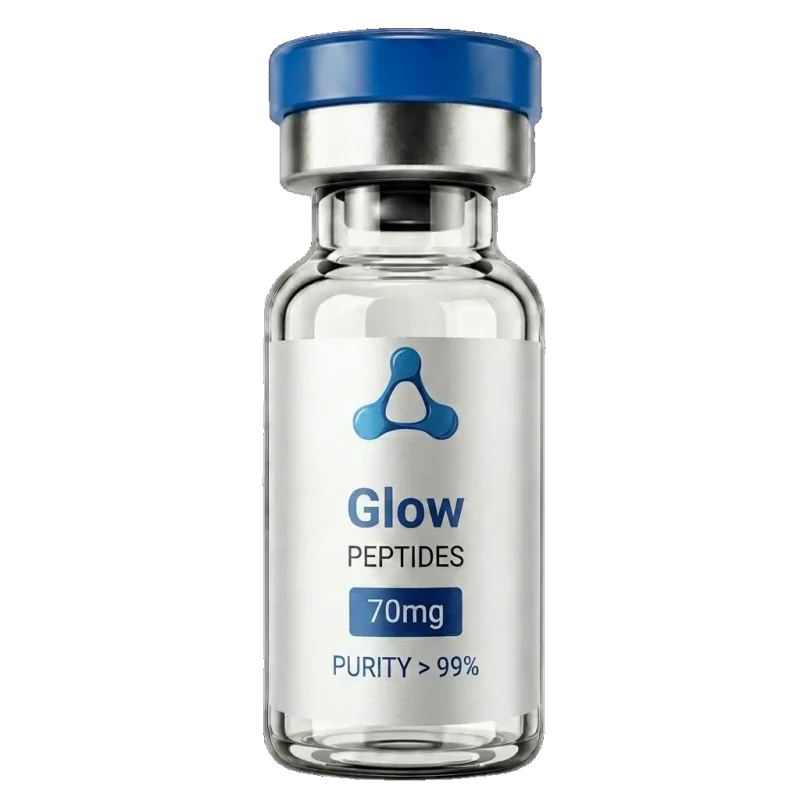
Glow Blend is a 70 mg combo vial listed by the supplier under cosmetic-skin use. IMPORTANT — UNVERIFIED COMPOSITION: the exact composition is NOT disclosed by the supplier on the label. The working assumption documented here — a combination of glutathione (a γ-Glu-Cys-Gly tripeptide and endogenous antioxidant) and vitamin C (ascorbic acid, a small-molecule antioxidant) — is a plausible but UNVERIFIED assumption and must be confirmed with the supplier before any use. The per-component mass and ratio are likewise not disclosed. Strictly speaking, Glow Blend is not a peptide product in the pharmacological sense: glutathione is a tripeptide, but vitamin C is a small molecule; it is listed in the peptide registry as a pricing-only entry under the cosmetic-skin category because it appears in the same supplier table. Limited human data. Research use only.

Glow Blend – peptide vial product image

Identity & Chemistry

Amino Acid Sequence
Composition not publicly disclosed by the supplier. Working assumption (pending supplier confirmation): a co-formulation of (1) Glutathione — a tripeptide γ-L-glutamyl-L-cysteinyl-glycine, and (2) Vitamin C / ascorbic acid — a small-molecule antioxidant. Confirm exact identity, per-component mass and ratio before relying on any compositional claim.
Molecular Formula
Mixture — no single molecular formula. Working assumption: C₁₀H₁₇N₃O₆S (Glutathione, MW 307.32) + C₆H₈O₆ (Ascorbic acid / Vitamin C, MW 176.12). Composition pending supplier confirmation.
Molecular Weight
Not applicable as a single value (mixture). Component reference masses (if the working assumption holds): Glutathione ≈ 307.32 g·mol⁻¹; Ascorbic acid ≈ 176.12 g·mol⁻¹. Combined vial: 70 mg total mass; per-component split not disclosed.
IUPAC Name
Not applicable — multi-component blend. Glutathione: (2S)-2-amino-4-{[(1R)-1-[(carboxymethyl)carbamoyl]-2-sulfanylethyl]carbamoyl}butanoic acid. Ascorbic acid: (5R)-[(1S)-1,2-dihydroxyethyl]-3,4-dihydroxyfuran-2(5H)-one.

Mechanism of Action

Under the working assumption of a glutathione + vitamin C composition, studies report antioxidant effects through reactive-oxygen-species scavenging and inhibition of tyrosinase activity, which can lead to observed skin-pigmentation lightening. Observed in research settings.

Mechanistic statements are component-specific and rest on the UNVERIFIED working assumption of composition. A synergistic pharmacological rationale for the specific Glow Blend formulation has NOT been formally validated in peer-reviewed literature. Researchers who require a defined ratio should obtain glutathione and vitamin C separately.
Molecular Targets

  • Tyrosinase (key enzyme of melanogenesis) — glutathione component
  • Reactive oxygen species (ROS) — both components as antioxidants
  • Collagen synthesis (vitamin C as a cofactor of prolyl / lysyl hydroxylase)

Signaling Pathways

  • Glutathione: oxidative-stress reduction; inhibition of the eumelanin-forming steps of melanogenesis
  • Vitamin C: ROS quenching; cofactor for collagen hydroxylation; photoprotective effects

Research Applications

No peer-reviewed clinical trials exist for the specific Glow Blend formulation. The available evidence consists of separate studies of each assumed component on its own.

Glutathione — skin-whitening (small randomised trial)

Phase II

Studies report improved skin lightening and melanin-related parameters with topical oxidised glutathione versus placebo in healthy women.

— Watanabe et al. 2014, Clin Cosmet Investig Dermatol 7:267-274 (PMID 25378941)

Vitamin C — skin health (review)

in vivo

Studies report antioxidant, photoprotective and collagen-synthesis-supporting effects of vitamin C in skin.

— Pullar et al. 2017, Nutrients 9(8):866 (PMID 28805671, review)

Clinical Status

Regulatory Status
Neither glutathione nor vitamin C as a cosmetic blend is approved as a pharmaceutical combination product by the FDA or EMA. The specific Glow Blend formulation is NOT recognised by any regulatory agency; it is research material only.

Safety Profile

Observed in research settings

Limited human data. Observations derive from each component on its own; systemic pharmacovigilance data for the specific Glow Blend form do not exist. Observed in research settings.

Adverse Events Reported in Studies

  • Injection-site reactions (reported, both components)
  • Transient skin irritation (reported, infrequent)

References

  1. Sonthalia S, Daulatabad D, Sarkar R Glutathione as a skin whitening agent: facts, myths, evidence and controversies Indian Journal of Dermatology, Venereology and Leprology 2016;82(3):262-272. 2016 .

  2. Pullar JM, Carr AC, Vissers MCM The roles of vitamin C in skin health Nutrients 2017;9(8):866. 2017 .

  3. Watanabe F, Hashizume E, Chan GP, Kamimura A Skin-whitening and skin-condition-improving effects of topical oxidized glutathione: a double-blind and placebo-controlled clinical trial in healthy women Clinical, Cosmetic and Investigational Dermatology 2014;7:267-274. 2014 .

Frequently Asked Questions

What is Glow Blend?
Glow Blend is a 70 mg combo vial from the supplier table. The exact composition is NOT disclosed on the label. The working assumption (glutathione + vitamin C) must be confirmed with the supplier before any use.
In what ratio are glutathione and vitamin C present?
The per-component masses and ratio are NOT disclosed. Researchers who need a defined ratio should source glutathione and vitamin C separately.
Is Glow Blend an approved medicine?
No. Neither the combination formulation nor the assumed individual components are approved as a pharmaceutical combination product. Glow Blend is research material.